





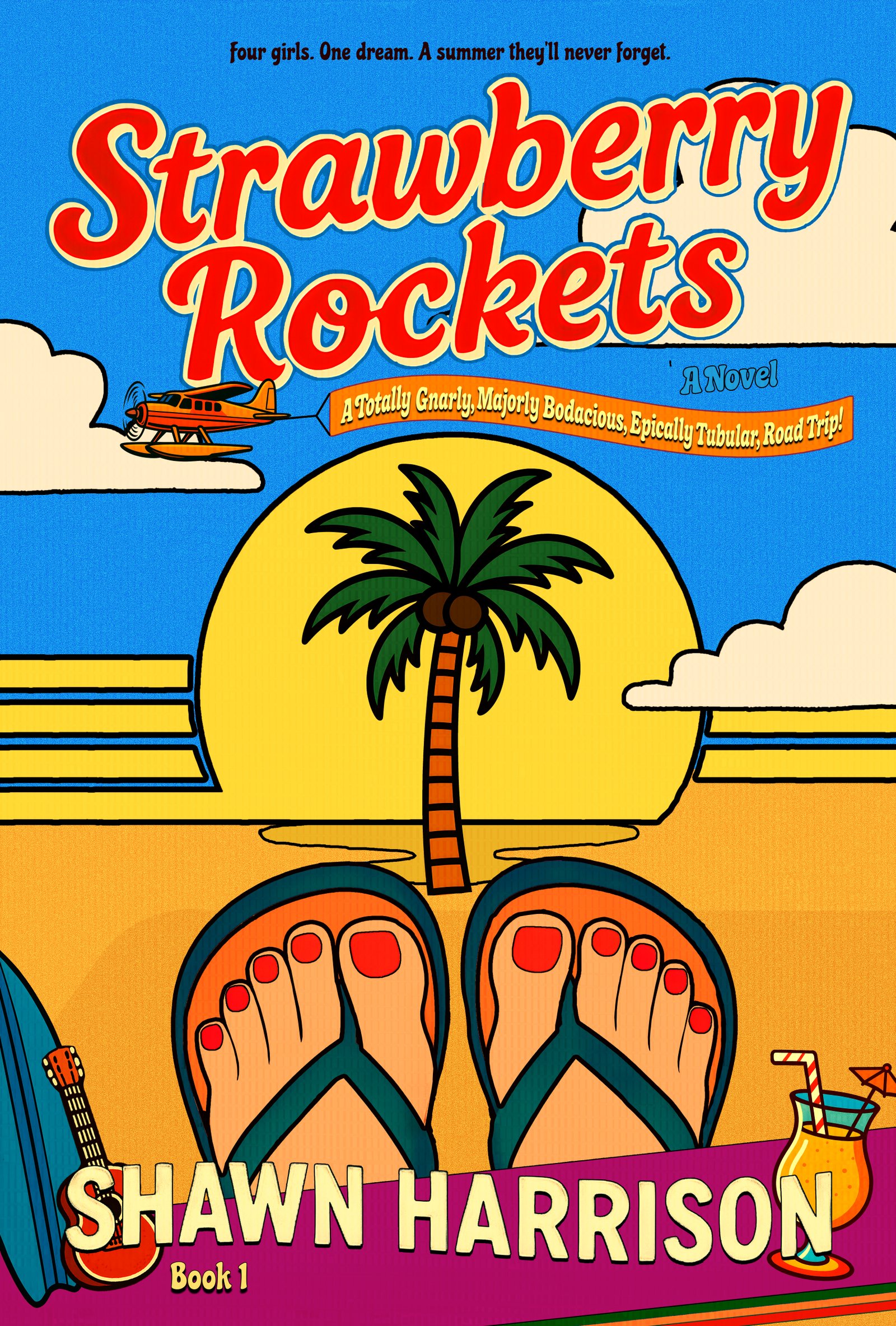
A Totally Gnarly, Majorly Bodacious, Epically Tubular, Road Trip!
Prologue
“It was a total flop, Hank!”
“Total?”
“’Fraid so.”
“What does that mean, Sammy?”
“In terms of…”
“In terms of money. How much money did we…” Hank paused, angry that he used the term we, and amended his question. “How much money did I lose?”
Sam ‘Sammy’ Marin flashed Hank a regretful glance before answering. “About fifty-two thousand.”
Hank Peterson dropped his head into his hands and let out a sigh so full of sorrow that it lingered in the room like a physical thing, dampening the air with a tinge of depression. “Fifty-two thousand…” Hank repeated. “Sammy, when you said this was going to break the bank, I didn’t think you meant mine.”
Sammy took a drink of whiskey and wiped his bulldog mouth. A droplet of his drink remained, clinging to a hair on his mustache like a mountain climber hanging from a ledge. This inane detail bothered Hank in a way it normally wouldn’t. In fact, the brightness of his office fluorescents bothered him in a way they never did before. The noise of the traffic outside bothered him like it never had before.
Fifty-two thousand dollars! He’d never lost so much money in his life. Suddenly, everything bothered him.
“I wish I had answers for ya, Hank. Me and your pappy made a killin’ in the movie business.” Sam leaned back in his chair. It let out a squeak so loud it could have only been caused by the shifting of a properly stout man. Then he crossed his arms, deep in thought. “I have an acute eye for details. ‘Least I did. I’m… I’m in touch with the… the… whad’a ya’call’it, pulse of society. ‘Least I was. It could be the landscape is a’changin’…” he huffed before finishing, “…it’s a’chagin’, and leavin’ me in the dust.”
“A lot of good that does me, Sammy,” Hank sighed again before taking a drag off his cigarette. Then he ran a nervous hand through his full head of salt-and-pepper brown hair, wondering how he would explain this to his sister and current business partner, Sissy Peterson. Before this bone-headed move, he’d discussed financial decisions with her; she’d invested a lot in the drive-in, too. The only reason he kept this from her was that it was a sure bet. Sammy said so. And he never knew Sammy to lie. According to the producer—his old pal—Hank would double his money.
Of course, that was a fine excuse he told himself to try and feel better. Deep down, he knew he didn’t tell her because she would’ve objected. Maybe she would’ve agreed to a lower investment amount, but she didn’t know Sammy—the man who’d made his father a nice sum of money—like he knew him.
At least he thought he knew him.
The two men sat in Hank’s office. A mixture of low-budget and Hollywood-produced movie posters adorned the walls. Hank didn’t choose the posters based on popularity, genre, or return, but for their colorful, artistic appearance. These included Vertigo, Breakfast at Tiffany’s, Barbarella, Jaws, Pink Flamingos, and The Evil Dead.
Boxes of different sizes were stacked on almost every bit of counter space. Movie reels stuck out of the top of most of these boxes, while others carried advertising material for Strawberry Rockets Drive-In Theater. A shelf affixed to the wall behind Hank held stacks of movie scripts. These were some of his prized possessions. He collected and read them like most people collected and read novels. He studied them like a curator studying fine art, and in his spare time, he wrote some of his own.
Since the age of fifteen, Hank had dreamed of having one of his scripts find its way into the hands of a capable producer who’d be interested in turning it into a film. Problem was that, over the past thirty-seven years, all the capable producers who got their hands on his scripts rejected them. So when Sam Marin came along needing a producer for his latest picture, Hank jumped on the opportunity, seeing it as a chance to get his foot in the door. His father loved producing a Sam Marin original. And although he wasn’t the most respected man in the business, he did have connections.
Now, after months of anticipation, Hank Peterson found out the first film he produced had failed. And, according to ole Sammy, it failed pretty big.
“Do you have anything for me?” Hank asked.
“Anything, as in what?”
“I don’t know, Sammy. Anything? I mean, I financed your movie. I… I invested in it. And… all I get back is you telling me it was a flop?”
“My poor bank account is dead tired, Hank. Dead tired. I got nothin’ for ya.”
“Perfect. What about future distribution? Can I make anything back on that?”
“I’m gonna level with ya, Hank. After these screenings, no studio’ll take this.”
Hank diverted his gaze. Along the base of the walls and under the counters, more boxes sat. Most of these contained rolled-up movie posters. Others harbored things like fresh toilet paper rolls, toilet seat covers, brand new Styrofoam Dixie cups, wrapped French-fry cups, paper towels, plastic knives and forks, and paper plates; some of the essentials to run a drive-in. The clutter of boxes didn’t allow Sammy and his large frame to move more than a few inches in his rolling chair without knocking into something. He was as cramped as a bulldog in a chihuahua’s dog house.
Unlike the unorganized look of the countertops and floor, Hank’s desk portrayed a fine example of order. A banker’s style lamp sat beside the typewriter at the center-top of his desk. Paperclips, pins, rubber bands, pencils, and pens all had a place in a plastic desk organizer. Neatly stacked rows of paper sat near the phone. Wooden paperweights with various titles wood-burned into them lay on top of each pile. These titles included: ‘BILLS’, ‘INVOICES’, and ‘SALES’. The stacks under the ‘BILLS’ and ‘INVOICES’ paperweights were taller than the stack under the ‘SALES’ paperweight. This was always the case, but now, after losing over fifty grand, the difference between the stacks seemed much greater.
“This is the way these things go sometimes,” Sam said. “Investments aren’t foolproof. What can I tell ya? I wasn’t tryin’ ta make a pisser of a pit’cher. These kids now-a-days, they’re talkin’ different and dancin’ different, they have different interests…”
Hank’s shoulders slumped. “Why didn’t you tell me this when you came to me for the money, Sammy?”
“I didn’t know it then. Honest engine.” Sam held up his left hand as a visual indicator of his honest engine statement. “Hank, I really thought I coulda done with you what I did with your pappy. It hurts me that this happened. If I thought this pit’cher was gonna lose as much as it did, I wouldn’t’a come to ya for the backin’. Hell, I wouldn’t’a made the damn thing. You gotta remember, I lost on this too, ya know. Hell, I’d say I lost somethin’ more than my shirt…”
“What’s that, Sam?”
“I lost my reputation.”
Hank rolled his eyes. He knew Sam didn’t have much of a reputation to begin with. At least not with reputable movie directors or producers. Just because his pictures… or pit’chers, as he labeled it… turned a profit back in the forties and fifties didn’t mean the flicks weren’t low-brow and often silly schlock; movies made specifically for the drive-in scene. The kind of film that, if you were necking with your favorite girl, you wouldn’t miss enough to be lost when you got back into it. The drive-ins loved Sam Marin pictures.
“Hank, let me tell ya a story about the first pit’cher I ever filmed. There’s a lesson to be learnt in it…”
While Sammy spoke, Hank didn’t look at him. He couldn’t look at him; anger wouldn’t allow it. Instead, he tuned him out, opting to gaze upon a picture frame on the corner of his desk. His stare remained fixed there for a long moment. Inside the frame was a family photo of Hank’s late wife, Carolyn; his sons, Luke and Hank Jr.; and his daughter—the youngest of the bunch, at nineteen—Audrey. In the picture, Audrey was fourteen. It was taken a month before his wife’s death.
One big happy family standing in front of Strawberry Rockets’ concession stand. The view of his family hurt. Yet he forced himself to keep the gaze as punishment.
These are the people I hurt… and they don’t even know it.
Smoke from the cigarette resting in the ashtray drifted up in a fine tendril, obscuring the photo in a foggy haze. It seemed a fitting analogy. A mask of worry and embarrassment darkened his face like a tornado’s shadow over a lone farmhouse.
His head lolled to one side, and he finally had to turn away from the image of his family, unable to take it any longer. He didn’t know how he’d explain any of it to his children.
“…And that’s how I turned a bad situation into a positive,” Sam finished. “It’da do ya good to follow my example. You know what I mean?”
Hank agreed even though he hadn’t heard one word of Sam’s story.
“I knew things weren’t goin’ well when after the first showin’, I overheard two youngin’s talkin’. They was sayin’ how lame the pit’cher was. That got me a little worried, so I asked the usher—a young man, himself—what he thought of the flick, and he—not knowin’ my relation to the pit’cher—said it was lousy. He told me kids don’t talk that way no more. At first, I thought, eh… what does this wet-behind-the-ears young punk kid know? Probably just got outta the habit of eatin’ his boogers. But then the weekly numbers started comin’ in. That’s when I realized the kid may’ve been on to somethin’. After the second week… I knew the snot-nose was on ta somethin’.”
Hank removed a piece of paper from under the weight marked ‘BILLS’, and stared at it. “Sammy… What the hell am I supposed to do with this? I was counting on that money.”
“What is it?”
Hank handed him the sheet of paper. After taking a moment to read it over, Sam rubbed his chin and said, “Hell if I know, Hank. All I can say is I’m as sorry as a sinner who didn’t repent ‘fore bein’ struck by lightnin’.”
“Yeah, Sammy,” Hank said, blowing out a plume of cigarette smoke, “So am I.”
A soft knock sounded at the door. “Only one person I know knocks that softly,” Hank said before calling out, “Come on in, Audrey.”
Hank’s daughter, Audrey, opened the door and stood in the entranceway. “Hey, Dad, me and the girls are going to start setting up. We’ll probably be ready to play in about an hour and a half.”
“Sounds good, hon.” In that moment, looking at his daughter had a lot in common with a swift, hard blow to the back of the head. The number, fifty-two thousand, circled in his head, along with the question: Is my little girl going to be disappointed in me?
“Audrey Peterson,” Sammy said, his eyes bulging, “By golly, the last time I saw you, you came up to my knee. I bet you don’t remember me.”
“I’m sorry, I don’t, sir.” Every inch of Audrey’s five-foot-seven frame exuded a charismatic beauty rarely seen outside a Hollywood blockbuster. From her long brown hair to her deep brown eyes and keen fashion sense, most men took second and third takes when passing her on the street. And she knew it, showing it with a confidence that radiated off her.
“What’s this sir stuff? Call me Sammy. That’s what my friends call me. Boy, you sure grew into a beautiful young woman.”
Hank shot Sammy a glare. The old guy didn’t notice; his eyes remained fixed on Audrey. Hank saw how men looked at his daughter, and he didn’t like it. Now, he saw the same lust in Sam Marin’s eyes.
“Thank you, sir. I mean, Sammy.”
“Sam…” Hank grumbled. “Someday your eye for details will get you in trouble.”
Sam cleared his throat and looked away from Audrey. He felt Hank’s angry eyes on him. He rubbed his nose, then took another drink, still not looking at Hank.
A wave of embarrassment came over Audrey, both at Mr. Marin’s attention and her father’s acknowledgment of it. She looked down at her shoes as she shifted from one leg to the other.
“I think I oughta get goin’ old buddy,” Sam said.
“Yeah, that’s probably a good idea,” Hank said, his voice cold.
“You don’t have to leave on my account,” Audrey said.
“Naw, little lady,” Sammy said, making sure not to look at Audrey when he addressed her. “I have other business to tend to. Hank, I’ll catch ya on the flip side.”
“Sure,” Hank said.
Audrey stepped out of the doorway so Mr. Marin could leave. Once he was gone, Audrey asked, “Can I turn the sign on?”
“Yeah, go ahead, hon,” Hank said, staring at the paper.
“You okay, Dad?” He didn’t respond. “Dad? You okay?”
A moment passed before Hank said, “Yeah. Go on and have a good concert.”
Audrey flipped a switch on the office wall, near the door. Nothing in the room came on or went off. However, outside, on a marquee above the one-story building, a neon sign reading: Strawberry Rockets Drive-In, Hagerstown’s Number One Place for Fun, lit up.
“I’m lighting a sign, and I’m not even sure I’ll be able to pay the electric bill,” Hank whispered.
“What, Dad?”
“Nothing, hon. Go on, now.”
Audrey shut the door softly, allowing her father to be alone to wallow in his misery.
Chapter 1
“You gotta give it to me! You gotta give it to him! When we’re all in the hole, you gotta live with the sin! Will you pick up the pace, or get hit in the face? With the whole damn world thinkin’ you’re a disgrace.”
In the parking lot of Strawberry Rockets Drive-In, about two hundred people gathered around a small stage, watching the all-female quartet, The Allurettes, jam out in front of a massive silver screen. The song, a four-chord rocker, caught the attention of a few audience members. Some stood before the stage, dancing and having a good old time. Most hung around smoking and trying to talk over the music, waiting for sunset and the start of the movies. Despite the small crowd and lackluster attitude, singer and rhythm guitarist, Audrey Peterson, sang her lyrics with energy, doing everything she could to get people’s attention.
“If there’s a tale you can tell. You gotta make sure it sells. And when the feeling is right, I might stay for the night.” Audrey finished this line with a wink.
This innocent gesture caught the attention of Nester Ingleburn, who stood in the front row, directly in front of Audrey (his normal spot). Thick, black-rimmed glasses rested on his nose. White tape, wrapped around the bridge of his glasses, held together a break in the cheap plastic. About a hundred and two pimples covered the poor guy’s grease-shined face and, as always, a long cowlick stuck up on top of his head. He neither danced nor sang along; he only bobbed his head, seemingly averse to finding the beat. His eyes stayed fixed on Audrey, and when she winked, he smiled widely. He waved at her, trying to get her attention, and when she looked over, he blew her a kiss. Audrey looked away, smiling and shaking her head.
In high school, Audrey remembered Nester being the kid most likely to have a ‘Kick Me’ sign taped to his back. She also recalled his massive crush on her. Which was fine, but she rarely talked to him. Although embarrassed to admit it now, during her time at Thomas Jefferson High, she had a reputation as one of the cool kids and didn’t want Nester cramping her style. On the other hand, she was never mean to him. If he ever said hi to her in the hall, she’d always acknowledge him; she just never went out of her way to do the same for him.
With her prized 1977 Gibson Artisan, natural wood tone, guitar hanging from her shoulder, Audrey improvised the lines, “Oh, do you love it?”
A few in the crowd shouted back, “Yeah!”
She wore flip-flops—her usual choice of footwear—blue jeans with rips in the knees, and an orange shirt with the word KIX written in blue font across the front. Audrey didn’t wear the shirt for its intended purpose—an ad for the breakfast cereal. Instead, she wore it in support of the rock band Kix. Since she couldn’t find a Kix shirt, the cereal graphic shirt was the next best thing. And so no one misunderstood, underneath the KIX font, Audrey had scrawled the words: Atomic Bombs—her favorite Kix song—in black magic marker.
At this point in their song, drummer Marty Robbins pounded out a ten-second drum fill. The young, leather-jacket-clad percussionist moved with the grace of a drumming veteran. This got the attention of some of the uninterested folk. Then, as soon as her drum fill ended, lead guitarist Shelby Ashlyn busted in with a killer eight-bar solo. Anyone still not paying attention turned their head to see. Some made a fist and pumped the air while more began dancing and rocking out.
Bass player Krista Fleming, wearing her signature pink-and-white roller skates, rolled over to Audrey and shouted, “That got ‘em, didn’t it?”
Audrey couldn’t hear what the pretty blonde bassist with the Farrah Fawcett hairstyle said, but she responded with a broad smile anyway. She knelt beside Krista, put her right arm around the bassist’s leg, and strummed her guitar strings with her right hand. Nester flipped at this move. His eyes almost came out of their sockets, and his mouth fell open.
After the solo, Audrey, Krista, and Shelby turned their backs to the fans and, while they continued playing, performed a synchronized dance. Audrey could only imagine Nester’s reaction to this. Someone would probably have to roll his tongue back into his mouth. While facing the screen, Audrey saw the tops of the trees swaying in a stiff wind blowing over them. It felt good against her hot skin.
When the girls, remaining synchronized, turned back to face the crowd, Audrey noticed her father walk out of a small shed on the far side of the screen. He held a mop and crossed the parking lot, disappearing into the main building without glancing at the stage once.
His determined stride told her all she needed to know; he must’ve been mad about something. Usually, if he caught one of their performances, he’d watch for a moment before returning to his work. Also, he had a mop in his hand, which meant he was on his way to clean up a mess. Janitorial work never appealed to her father. Yet, Chip, Strawberry Rockets’ janitor, didn’t start his shift until four in the morning on weekends, when people began leaving.
The back of Strawberry Rockets Drive-In bordered a wooded area. To the band’s left, the sun touched the tops of the trees, burning a bright orange stain on the sky. The girls stood in the growing shadow of the massive white screen behind them. In front of them, a constant line of cars flooded through the entrance gates off of Garrison Avenue, finding parking spots; spots where some would remain for about eight hours, until sunrise.
When the solo ended, Krista skated over to her mic, and Audrey approached hers. And while Krista pounded the open A string on her bass and Audrey beat the A5 chord on her guitar, the two sang, “Give it to me!”
Audrey and Shelby then played a one-bar riff before repeating, “Give it to me!” The two girls sang this line two more times before the song ended.
The crowd cheered. Due to so few people standing in the expanse of the three-acre parking lot, the clapping and whistles sounded meek and hollow.
“Thank you,” Audrey said to the audience. “We’ve got one more song for you, then it’s movie time.” A smattering of cheers met her announcement, and about a fourth of their audience walked to the concession stand, while another fourth strolled to their cars, preparing for showtime. Half, including Nester, stayed put in front of the stage.
This encouraged Audrey. During last weekend’s performance, only a fourth of the audience remained until their set ended.
“This is the first time we’ve performed this song live,” Audrey continued. “It’s not finished. We all think it needs one or two more verses. Oh well. Inspiration will hit someday, and we’ll finish it. Our lead guitarist and pianist, Shelby Ashlyn, wrote what we have two days ago. You guys’ll be the first to hear it.” Shelby, now sitting before her Yamaha DX7, smiled and waved. “It’s called Gone Away.”
Shelby began playing a slow intro melody using a fair number of black keys. After the intro, Audrey sang, “Tell me what I did to deserve this. You played me like a fool. When the lies you told were my only truth, these were lessons never taught in school.” After this line, Krista introduced a slow bass line, and the softer side of Marty’s drumming shone through as she began playing, too.
“Tell me how we got here. How our gold turned to brass. How this muscle in my chest could break so easily? As easily as glass. Gotta get away to nowhere. Gonna start fresh again. Tonight is the last time you'll see me. Tomorrow I'll be the wind.
As the sun sank below the horizon, the parking lot filled with vehicles. With the cars came more people. At least three hundred or so—most in their twenties—milling about, finding and talking with friends, going to the concession stand, tailgating, dancing, and listening to them play. The drive-in was alive, just how Audrey liked it.
What she didn’t like was ending their set on a ballad. It didn’t occur to her until Shelby began playing, and it bugged her that she didn’t think of it sooner. They should’ve ended their set with an edgier number; something with more of a bite. That would’ve been more memorable.
Regardless, Audrey continued singing, “The tether here has broken, and there's nothing you can say. Tonight is almost over. I'm gonna fly away. I'm gonna fly away.
Scanning the crowd, hoping to see more people paying attention, she noticed Jubal Peabody, Strawberry Rockets’ resident crotchety old man, patrolling the area. She relished the familiar sight; another fixture from her childhood. From his bright white hair and white mustache, curled into a spiral on either side, to his bushy eyebrows that had never seen a trimmer, and his permanently creased brow, he was one person who couldn’t blend into the young and hip crowd.
Hank, a traditionalist at heart, wanted to run a family-friendly business. That meant nothing ‘nasty’, his words, happening in his parking lot. So, years prior, he hired Jubal Peabody to make sure no hanky-panky took place within the borders of Strawberry Rockets. If Jubal saw a teeter-tottering car or fogged-up windows, he’d bang on the window with his long flashlight and warn the offenders to knock it off. The first warning meant just that. The second time, you were banned from the drive-in.
In a way, Audrey thought this warning was unfair, and no one took it seriously, because Jubal had one of the highest voices she’d ever heard on a man. It was comical, actually, watching the bushy-browed old man chastise some young couple in a voice resembling Tiny Tim, the ukulele player.
The band continued their song as an instrumental for another couple of minutes. Audrey considered improvising some lines to finish the song with, but when nothing came to mind, she simply sang, “Gonna fly away. Gonna spread my wings and fly away.”
Once they were through, everyone, still paying attention, clapped. Nester added a loud whistle. Of course he would.
After the show, the girls began packing up their gear, preparing to stuff it into Audrey’s 1979 Plymouth Voyager. She surveyed the lot for signs of Nester.
“Nester the pester didn’t stick around tonight?” Krista asked.
“It doesn’t look like it, and thank goodness.”
Audrey stood beside the van’s open side door, taking guitar cases, amps, stands, and keyboards from her bandmates and fitting them into the back like a puzzle. After doing this so many times, she had it down to a science. If they got a new piece of equipment, she’d spend an hour figuring out how to fit it perfectly.
While they unloaded their stage, advertisements began playing on the drive-in’s massive screen. Audrey looked up and saw ‘Roaring’ Rick Richardson, the boisterous owner of Richardson’s Automotive, a local used car lot. Currently, the pot-bellied man stood beside a 1975 red Corvette, with the words: Crazy Prices! overlaid on the screen. Although ‘Roaring’ Rick didn’t patrol the grounds of Strawberry Rockets like Jubal Peabody, his ads were as much a part of Audrey’s childhood as the old man. She grew up hearing about his insane used car deals. The big guy with a consistent case of flushed-colored cheeks, who always seemed an angry word away from a heart attack, starred in his commercials. From the cars being filmed in shadows to the half-moon sweat stains under ‘Roaring’ Rick’s arms, the ads were the pinnacle of bad filming; perfect drive-in schlock.
On the bottom of the massive screen were the words: TUNE TO 101.5 ON YOUR FM DIAL. Because the van’s radio wasn’t on, she couldn’t hear ‘Roaring’ Rick hawk his latest deals.
“Hey! Hot stuff! Over here!”
Looking over her shoulder, Audrey saw a man with slicked-back hair and wearing a motorcycle jacket standing near the front of her van. “Yeah?”
“I got something for ya!”
“No thanks,” Audrey said, turning away.
“No, seriously. You’ll be interested in this.”
“She said no,” Krista said, walking up to the van and handing Audrey one of Marty’s cymbals.