

Chapter Two
1.
Sidney Prescott left Helen Rogers Medical Center and got into her car. Adjusting the rearview, she gazed into her own eyes. For the first time, she didn’t recognize the person staring back at her. Considering everything she had been through, this unfamiliarity was quite the epiphany. Life had caught up to her with a vengeance. Recalling a line from a poem, she thought, Time comes, and it goes; too soon, we all eventually fade.
“Other things never change,” she said to herself.
Over the years, she had set some hard boundaries for herself—coping mechanisms to deal with her rather tumultuous life. One of these boundaries was to watch as little news as possible. In her mind, one feel-good story of a puppy rescued from a well could never eclipse the oppressive dread that stirred within her from the many morbid stories. So it was quite a shock when she looked up at the television in the doctor’s office waiting room and saw a headline scrawled across the screen: ‘Ghostface Killing: Shocking Video Streamed Live’. She only hoped her name wouldn’t be resurrected and dragged into this. Whether her name would be brought up or not, that familiar sense of dread washed over her.
She couldn’t get the newscaster’s description of what happened out of her head. A knife to the skull—much the same way one of the police officers tasked with protecting her fourteen years earlier had been killed.
And to think people kept reposting it online. What has this world become? Then she thought of what Billy and Stu had done… and what Mrs. Loomis and Mickey had done… and she couldn’t forget Roman—oh, the hell with it. The world hadn’t changed; it was exactly the same as when she was younger. Lest she forget, millions have been entertained by the Stab movies, movies inspired by her real life. She supposed she should take some solace in knowing she still hadn’t gotten used to it.
Refocusing on her reflection in the rearview, particularly the two silver streaks running through her hair—gray that seemed to have snuck up on her over the past few months. She thought it made her look a little like the character Nancy Thompson from A Nightmare on Elm Street. She rubbed her temples and closed her eyes. Outside, early spring trundled along—blue skies, a sixty-eight-degree high, a light breeze, and birds chirping in a pair of parking lot trees. The contrast to her current mood couldn’t have been greater. Two tears, one from each eye, rolled down her cheeks. “Get yourself together,” she said after taking a deep breath and exhaling slowly.
Pressing the ‘Push Start’ button on her dashboard brought the engine to life and filled the cabin of her Equinox with a low purr. On the radio, a DJ read a promo for his upcoming guest, “Tomorrow we have Heather Graham discussing her cameo in the latest Stab movie. How can someone who was killed in the first movie have a cameo in the tenth? We’ll find out tomorrow. Plus, can you believe License to Drive will be forty years old in a few years? Let’s see if she has any juicy behind-the-scenes stories about working with—”
Sighing, Sidney turned the station to 101.7, WKLM: All 90s All The Time. There she found Pearl Jam singing, ‘Daughter’. A song from her past. This sounded right for the moment. After buckling her seatbelt, she caught another glimpse of herself in the rearview. Tired of the stranger she was becoming, she looked away and pulled out of the parking lot.
2.
Glenn Frey’s, The Heat Is On, played from a cell phone on a nightstand beside a king-sized bed occupied by two people. An arm shot out from under the covers, grabbed the phone, and turned off the alarm. A few seconds later, Dewey Riley threw off the covers, swung his legs out of bed, and sat for a moment, running a hand through his short, graying hair.
Morning sunlight poured in through the large window facing the bed. It took a moment for his eyes to adjust to the world beyond the covers. When they did, he swiped down on his phone to check his overnight messages. There were two. The first came from fellow Woodsboro officer Harwich at 2:04 A.M. It read: “Sheriff, call me in the morning. I think I have some bad news. I’d call, but I know it’s your anniversary and don’t want to disturb you and the missus.” The other message came in only a few minutes before his alarm went off and was from Sidney: “Dewey, give me a ring if you get a chance. I need to talk.”
Next, he yawned and arched his back, disliking the slight ache he felt and the subtle crack he heard. Rubbing the sleep from his eyes, he stood and stretched as he strode toward the bathroom, feeling like a zombie from Night of the Living Dead. On his way, he decided to call Sid first, then Harwich; old friends come before co-workers. However, both would have to wait until he had fully become part of the land of the living.
The bed’s other occupant threw off her covers and rolled over, and watched her husband, offering him a loving smile.
“You ready for your last week, Sheriff?”
“Don’t call me that,” Dewey said, turning to her and flashing his aw-shucks grin—the one his wife fell in love with the first time she saw him. “I need to get used to being Dwight Riley without the title.” In the bathroom, he turned on the cold water, looked into the mirror, and rubbed the beginnings of a beard clinging to his cheeks. “You think I should shave this?”
“No,” she said. “It gives you a dignified look.”
He splashed water on his face. The chill helped wake him.
He turned on the radio over the sink—WTOQ Woodsboro’s Home For ‘Round the Clock News. This radio was rarely tuned to anything but WTOQ. For fourteen years, ever since Jill Roberts and Charlie Walker’s killing spree, Dewey made morning news updates a part of his morning routine. After his fourth go-around with Ghostface, he felt compelled to know whether anything had happened overnight. Over the years, this need waned a bit, and he didn’t always stick to the routine. However, since he and his wife had celebrated their anniversary the night before and he had cut off all communication with the station, this morning he decided to check what he might’ve missed.
“Pot Belly the pig disappeared two days ago,” the radio broadcaster blared. “The swine won the blue ribbon at last year’s County Fair. The pig’s owner, Hugo Frost, said of the missing animal, “There’s a big hole in the hearts of my family.”
Rolling his eyes, Dewey said, “What a case to end a career on; a missing pig.”
“Who knows,” his wife said, “if it’s found dead, you might get a good meal out of it.”
Knitting his brow, Dewey looked at her, a ghost of a grin tugging at his lips. For a second time, he rubbed the heavy stubble on his cheeks, mapping out the plan of attack his razor would take. Despite his wife’s opinion, he had grown tired of the beard before it got out of its diaper stage. “You really should be the one taking my spot,” he said. “I can’t believe you lost the election to Ward.”
“It’s okay,” Deputy Judy Riley said. “It’ll give me more time to spend with you during your retirement. Oh, last night, I made you some lemon squares before I went to bed. That way, they’ll still be fresh for lunch.”
Under his breath, he said to his reflection, “I wish I would’ve never told you I liked those things.”
“What?” she called from the bedroom.
“I said how much I love those things.”
“In other news,” the broadcaster continued, “Tragedy struck in Sonoma Bay last night. A disturbing new video is circulating online showing someone who appears to be dressed as the infamous Ghostface killer—a costume popularized by the Stab movies—murdering a young man.”
Dewey locked eyes on the small Panasonic radio.
“Sonoma Bay,” Judy said, getting out of bed. “Just down the road.”
“Jesus,” Dewey said, turning up the radio.
Social media posts link the video’s origins to a horror-movie-themed podcast named Scream A Little Stream hosted by Brad Anderson and Kinsley Saunders. Both are said to be students currently enrolled at Woodsboro Community College. YouTube and Twitch—the platforms that carried this podcast live—have declined to comment, but the video in question has been removed from both sites.”
“Looks like your last week won’t be so slow after all,” Judy said, standing in the bathroom doorway.
3.
Preferring counter seating, Gale Weathers stared at a display of doughnuts on a silver tray, looking beyond them, daydreaming. Maybe daydreaming wasn’t the right word. Maybe… reflecting… Yeah, she sat, reflecting on the choices she’d made throughout her life. With a birthday coming up, these thoughts took on a depressing quality.
‘Pinggggg’
Another news notification. The fifth since she woke up. Like the others, she didn’t check it. Something awful was going on out in the big bad world; what else was new? They’d be talking about it when she got to work. She sighed and kept looking at the doughnuts.
Few chose Sam’s Delicatessen to prepare for another day in the trenches. She supposed that’s why she liked it; she could be alone with her thoughts. For Gale, morning prep consisted of a whole wheat raisin bagel to keep her regular and a coffee; backup, just in case the raisins didn’t work. She sighed and closed her eyes, wondering if Jane Pauley or Barbara Walters had as much trouble going down the ladder. Since starting her job as Head Editor for Quillory Magazine, she rarely looked forward to going to work. Hell, she rarely looked forward to getting out of bed.
She found her position ironic: an author who had succeeded in writing non-fiction but fell flat on her face when it came to penning an original yarn, editing a literary magazine. She knew the three staff writers had been mocking her behind her back. And why shouldn’t they? In some ways… in many ways, actually, she felt her employment mocked her failures.
In a booth behind her, the low whispers and soft giggles of three girls rose. Gale associated these sweet sounds with shared secrets. It reminded her of when she was a girl—a better time when the clock hadn’t yet held up a mirror in front of her, showing, with no mercy, the many failures she had reaped.
“Be more dramatic, Gale,” she mumbled.
“Pardon?” a waitress, scraping the leftovers of a breakfast sampler into the garbage, asked.
“Nothing.”
“Can I get’cha anything else?”
“No. Thank you.”
The cherry on top of her shit sundae came when Dewey announced his retirement. The town mourned his decision not to run again much the same way they mourn the memory of the Woodsboro murders every second Sunday in May—the designated memorial day. Maybe this was justified. He had been an officer during Billy and Stu’s massacre and the town sheriff during Jill and Charlie’s. In a way, they were losing another one of their heroes… A legacy character, she thought before taking a sip of coffee.
Dusty morning light slanted in through the open blinds, casting lines of shadow across the back of her clothing. Overhead, two ceiling fans, stuck on the lowest speed, squeaked the morning away. An aroma of coffee lingered in the air. Except for a whispered conversation at one of the tables, the giggling girls in the booth, the squeaky fans, and the sizzling sound of bacon on a griddle, the place was quiet.
She yawned, finding the action amusing: the more a person stays in bed, the more they yawn. A sad thought, that. Kind of like the longer you live, the more chances there are for regret.
Dewey, Dewey, Dewey.
Once the divorce was finalized, she moved to San Francisco with aspirations of becoming a player in the tech world. With her writing experience and level of celebrity, she thought she’d be a shoo-in—writing blogs for Google or penning features for Apple. Funny thing, though, she quickly found that the avant-garde world unreceptive to a woman of her seasoned age. Expenses piled up while opportunities dried up. In need of money and still having an apartment in Woodsboro, she returned, angry that she had failed to kick the small-town dirt of Woodsboro off her ballet flats in exchange for red-bottomed pumps, clip-clopping on the posh streets of Pacific Heights. When the head editor position opened at Quillory, she really didn’t have much of a choice.
Behind her, more giggles came from the booth full of estrogen. It occurred to her that they could be laughing at her. Suddenly, she felt like Cheryl Laine from Bret Easton Ellis’s The Informers. Of course, this was a silly thought; they weren’t laughing at her. A simple fact of life is that when you’re feeling down about yourself, you think everyone is laughing at you.
The waitress put the check beside her plate. “Whenever you’re ready, dear.
“Sure.”
More giggles. More whispers. She clenched her jaw. Damn those little brats. There was no reason to whisper. They had to be talking about her. Now the question was what to do about it. The answer was… well… nothing. What the hell could she do? If she were wrong, and they were discussing whatever teens talk about nowadays, she’d look like a lunatic. And if she was right, so what? People talked about her all the time.
Someone tapped her on the shoulder. She turned to find one of the little balls of glee. “Yes?”
The young girl—maybe sixteen, maybe seventeen—licked her lips, trying to hold in a giggle fit.
Yep, Cheryl Laine, indeed.
Sighing, Gale tried again. “Yes?”
“My friends and I were wondering…” She put a hand to her mouth to stifle another giggle.
“That’s good, keep it coming,” Gale urged, feeling sick that she had been right about the girls. “Off to a good start, you and your friends were wondering what?” Now she knew something else… what was coming. It’s what always came next. ‘Are you the famous Gale Weathers from Top Story and author of The Woodsboro Murders?’ She decided that, although annoyed at their titters, she’d give an autograph if they asked.
“Well… we were wondering if you’re the woman in the Bruce Springsteen video?”
Gale’s face dropped.
“You see, last night me and my friends were watching this guy on YouTube, Jake Severs—he watches, like, old music videos, and stuff, and reacts to them. And you look just like the girl in the video. A lot older, but in the face, it’s you.” When Gale didn’t respond immediately, the stammering girl went on, which made things worse. “I never miss his videos. I always find it kinda cool seeing what my grandparents were into back in the day, you know?”
“Look, you little twit, instead of giggling behind people’s backs, you should learn some manners.”
The girl stepped back and raised an eyebrow. “What?” she asked, her tone full of attitude. “Boomer much?” Turning, she said to her laughing friends, “Come on, guys, leave grandma to her oatmeal and coffee.”
As they left, Gale yelled, “It’s a bagel!”
Returning to her solitary spot at the counter, the waitress said, “Kids.”
“Yeah. Or as I like to call them, little shits.”
Outside, three cop cars—lights on, sirens blaring—pulled up in front of the delicatessen, causing the three laughing teens to jump out of the way. Gale turned around; her brow creased. Dewey got out of one car, Judy out of another, and Pierce Ward—Woodsboro’s sheriff-in-waiting—out of the third. They marched into the deli on a mission.
“Gale,” Dewey said.
“Dewey, what is this?” Gale asked. “And what is she doing here?”
“Gale, I’m here to protect and serve,” Judy said. “I don’t want to—”
“Will you shut up, Officer Judy Homewrecker!”
“Gale!” Dewey yelled. “Stop. You have to come with us—”
“Actually, I don’t. I have to go to work. You left me with a broken life, remember? I don’t have the luxury of even considering retirement.” She gave him a once-over after saying this.
“Gale, please. I have bad news.”
Knowing their history, Gale paid attention. “What is it?”
“The killer…” Dewey caught himself—it wasn’t the same killer; never was. “A killer… wearing the Ghostface mask is back. And he mentioned your name.”
4.
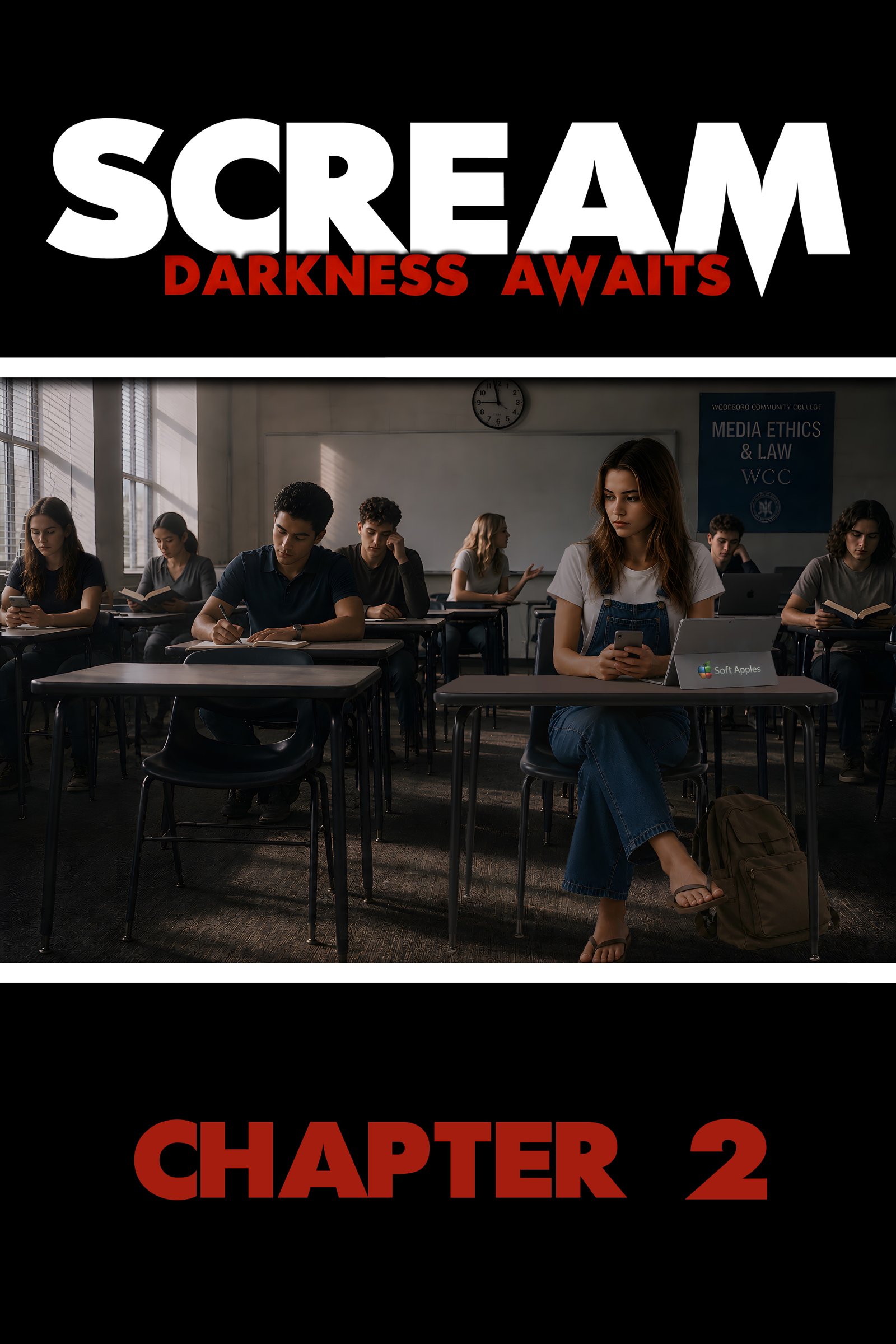
An unusual and disquieting silence settled over Professor Himbry’s Media Ethics and Law course at Woodsboro Community College. The normal sounds were there: the hum of the fluorescent lights, the distant drone of a rooftop HVAC, the ticking of the clock—the last analog clock in WCC. Yet the students weren’t as talkative. Considering they were discussing their last assignment, media turning trauma into entertainment, this was weird. Thoses who did engage spoke in a subdued tone, as if a blanket had been draped over their words.
Although five or six seats were unoccupied, only Kinsley Saunders’s and Brad Anderson’s mattered to the class. Rory Lang, a blonde-haired, brown-eyed, twenty-year-old, sat with her Microsoft Surface on the desk before her. Her fingertips hovered over the keys, but that’s all they did. She was too distracted to take notes. Instead, she directed her attention to the empty chair next to her.
“Rory?” Professor Himbry asked, snapping her out of her haze.
“Yes?”
“Do you have any thoughts on what Mr. Harris said?”
Any thoughts on what? She’d heard Evan jabbering about something, but hadn’t listened to a damn thing for the past ten minutes. “Um…” she began. “I, ah… no.”
A muted snicker arose from the classroom and quickly dissipated.
“That’s okay, Rory. I understand,” Professor Himbry said before moving on to someone else.
Reaching into the pocket of her denim overalls, Rory took out her phone and looked at one of the last texts sent to her. It was from Kinsley and read: Call me as soon as you get this. It came in at 11:31 p.m. Swiping up through past texts, Rory found Kinsley’s message mixed in with ten others. All had similar messages. Rory wasn’t watching Scream A Little Stream when the murder occurred; she was recording an episode for her YouTube reaction channel. But she knew something had happened when she checked her phone around midnight and saw all the messages. Then her friend, Yumi Mori, texted her a video of Brad’s bloody demise. Something she could’ve done without seeing.
She really tried to call Kinsley, but her fingers wouldn’t cooperate. This lack of attention to her friend’s needs made her feel like a chicken shit. In her defense, however, she had just witnessed a classmate die in a horrific way; her mind needed time to process something so terrible.
Shaking her head, frustrated with herself, she tapped on Kinsley’s message and began typing a response: My phone was silenced. ‘I didn’t see your message until this morning. I would’ve called then, but was running late for class.’ She stopped typing. With a sigh, she held the back button on her phone’s touchscreen, erasing the message—no need to be an even bigger coward and lie. Next, she typed: Sorry. I’ll call after class. Then she pushed send.
A few seconds after sending her message, a text notification sounded from the front of the room. Along with the rest of the class, Rory looked up. Her eyes widened when she saw Kinsley coming through the doorway.
“Miss Saunders,” Professor Himbry said, “I didn’t expect you today.”
“Well, here I am,” Kinsley said as she checked the text she had just gotten. Immediately, her eyes found Rory. Verbally, Kinsley said nothing, yet her accusing eyes spoke volumes.
Rory shrank into her seat.
Kinsley sat down at her desk, next to Rory. “I was at the police station all night,” she told Professor Himbry as she took out her MacBook.
“Under the circumstances, I understand, Miss Saunders. You don’t have to be here today.”
“I know.”
Clapping his hands together in a way that let everyone know it was time to get back to business, he said, “We were just in the middle of discussing our last essay assignment. Before you came in, Mr. Harris was arguing in favor of Netflix’s usage of AI in their promotional materials.”
“Figures,” Kinsley muttered.
“Speak up, Kinsley, I couldn’t hear you.” This voice, biting with sarcasm, came from the back of the class and belonged to Evan Harris.
“Mr. Harris,” Professor Himbry said, “are you willing to discuss the conversation at hand in a respectful way, or do you intend to antagonize Miss Saunders? Because if it’s the latter, this isn’t the time for that.”
Rory shifted in her seat. Not only did guilt over not calling her friend eat at her, but now she’d have to listen to her fight with the class ass. Numerous times, Kinsley and Evan held the class hostage while they exchanged wits. They seemed to be on opposite sides of every subject. And when they argued, it was like popping oil; not only would they burn themselves, but others could expect mild surface burns.
“Sir,” Evan said, “Our brave little heroine decided to show up today and participate. I can’t discuss the topic with her if I can’t hear what she’s saying. He had short brown hair, clean-cut and feathered. He wore a red button-up camp-collar shirt and a baseball cap that read ‘Woodsboro’ on its face.
This got the attention of Tyler Walsh, Rory’s boyfriend and reaction channel partner. He sat near the front of the class, drawing one of his horror movie cartoons in Freeform on his iPad instead of taking notes. The current composition was of Michael Myers standing alone in a field, a red tear running down his mask. A banner reading Family Reunion hung above his head. His friends got a kick out of his cartoons. He looked around at Evan, opened his mouth to say something, but closed it. To Rory, it looked like he didn’t want to get a surface burn.
“After everything I’ve been through,” Kinsley said, turning, meeting Evan’s glance, “you’d think you could leave me alone today.”
“Brad went through something worse,” Evan retorted.
Kinsley faced forward, shaking her head. “Now, I suppose, we’ll have to hear your ridiculous stance on AI.” Kinsley’s tone was aggressive.
“You haven’t heard my stance. How do you know if it’s ridiculous or not?”
“Any stance in favor of AI is ridiculous!” Kinsley snapped around in her seat to face her nemesis once again, her skin flushing.
“Come on, Kinsley,” Evan said, staring her down. “Editing some picture using AI isn’t a deal breaker ethically. The documentary was factual; the girl is rotting away in prison. No one watching received bad info.”
“Ah, yes,” Kinsley said, “The ‘What Jennifer Did’ controversy. It’s ironic the documentary was named ‘What Jennifer Did’ because what she did do was get caught and have her mugshot taken. What she didn’t do was smile like she won the Nobel Peace Prize.”
“Adding a little sauce in the form of a few altered pics didn’t hurt anything. The only people who got butthurt were those holier-than-thou AI rejectors.”
“If it’s a factual documentary, then why change anything?” Kinsley retorted. “Netflix knew exactly what they were doing. People may have sympathized with her story, but changing her mugshot from having a stoic expression to a wide smile changes the narrative. To me, an ‘AI rejector,’ a term I’ll take pride in, their use of it cancels out the facts. Now, you can’t sympathize with her at all because only a deranged psychopath could smile like that.”
“It helped get the story out there.” Evan rolled his eyes.
“Netflix didn’t even bother telling their audience about the AI changes. That’s abhorrent.”
“What I’m about to say might make me sound like the bad guy, for I know all the professors love the great Kinsley Saunders as much as Professor Himbry, but I think—”
“This is a journalism class,” Rory said, turning around in her chair, “not a drama class.” Rory looked at Kinsley out of the corner of her eye, hoping her action reestablished the loyalty she had to her friend.
“Ah, yes,” Evan said, upset with being interrupted. “Rory Lang, the heroine’s mousey little sidekick—the Scrappy-Doo, if you will.”
“Let’s keep disparaging comments out of this,” Professor Himbry said. “Facts only.”
“Sir, I’m merely pointing out a fact about our little Rory. I mean, look at the contrast. Kinsley, a loose-fitting gray turtleneck sweater—Massimo Dutti, I presume—designer jeans, leather ballet flats. Then we’ve got Rory… overalls over a faded graphic T—The Grateful Dead, I presume—and flip-flops… better sidekick wears, I’ve never seen.”
“Hey,” Tyler said from the front, “Watch your mouth.” Rory’s beau was brooding, with an athletic build. He wore a black, button-down shirt—open and untucked—with a henley shirt on underneath. He had dark brown hair—messy and stylized with pomade.
“And the cast grows,” Evan said, quite proud of his smugness. “Tyler Walsh. The boyfriend of the sidekick. The handsome one who just isn’t handsome enough to get the main character.” He then met Tyler’s gaze. “But you sure do want her, don’t you?”
“Do you wanna take this outside?!” Tyler asked, shooting up out of his seat; his brow knit.
“That’s enough, Mr. Walsh,” Professor Himbry said. His tone suggested he understood the outburst; Evan had a negative effect on most people. “And, Mr. Harris, if you have nothing more than personal insults to contribute, we’ll move on—”
“Oh, certainly, certainly, sir,” Evan said, adding ice to his tone. “Let’s move back to Kinsley and her hypocrisy. The straight-A student who takes ethics in journalism so seriously, but looks up to a hack like Gale Weathers. Might I add she runs a podcast—a money-making venture—out of Woodsboro; a podcast that, on a weekly basis, discusses the Stab movies—films that profited off the real-life murders that befell the very town she broadcasts from. Both the individual, Miss Weathers, and the podcast, Scream a Little Stream, are, at their heart, unethical.”
“Miss Saunders,” Professor Himbry began, “Usually I’d ask you to respond, though considering what you went through last night, we can continue this discussion at a later date.”
Ignoring her professor, Kinsley glared at Evan. “When someone documents a horrible event, they’re not profiteering. If an artist sells a painting or a musician releases a song, that’s not exploitation—”
“I didn’t say exploitation.”
“Profiteering means exploitation,” Kinsley spewed. “Look it up. When Gale Weathers wrote The Woodsboro Murders, she was documenting what happened while also analyzing the motivations and actions of the killers. It’s informative.”
“Bullshit. She wrote those books to make money.”
“Exactly. That’s her job. Journalism. She spent years learning her craft. What do you expect her to do? Once you graduate, what are you going to do with your journalism degree, huh? Volunteer to write about small-town dog shows and craft fairs while you take a job at Walmart to make money? No. You’re going to report on notable stories, and you’re going to get paid for it. Is it going to be profiteering when you do it?”
“You don’t know what I’m going to do—” Evan began.
“And the podcast Brad and I have… had… isn’t exploitative—”
“Are you kidding me?” Evan asked. “You treat those horror flicks like they’re The Godfather or something. The other day, you had a poll labeled: ‘Goriest Death Scene.’ I mean… our own instructor, Mr. Himbry, is a direct descendant of one of the slain during the Billy and Stu murder spree back in ‘96. Don’t you, Kinsley, find that kind of poll disrespectful to his nephew?”
“Please leave me out of this,” Professor Himbry said. “My uncle is irrelevant to this conversation.”
“Concentrating on the entertainment parts of horror films doesn’t make you a bad person,” Tyler said, addressing Evan. “It’s a way to face your fears in a safe way.”
Sighing, Evan shot back, “People like Gale Weathers, and Woodsboro’s resident heroine,” he met Kinsley’s eyes when he said this, “seem to concentrate too much on the entertainment aspect of journalism. Which, my dear, makes you a hypocrite.”
“Why do you have such a hard-on for Gale Weathers?” Rory asked, doing a bit of asphalt laying on the road to her future apology to Kinsley.
“I certainly don’t have that,” Evan said with a bit of oomph behind it.
“Did you ever talk to Brad about your concerns with our podcast?” Kinsley asked. “He was your best friend, wasn’t he?”
“Brad knew how I felt.”
“And…Did he have anything to say about it?” Kinsley asked.
“Let’s just say his opinion varied from yours.”
“B.S.”
“If everyone will indulge me, I’d like to provide one more premise, in the form of a question, which led me to the conclusion that our favorite—ethical—heroine is a hypocrite.”
“Just ask the question, Evan,” Professor Himbry said, growing tired of his flowery way of speaking.
“No problem, sir. Kinsley, is it ethical to rat out a fellow student?”
Kinsley’s glare intensified. So did Evan’s. Their scowls tangled in a wrestling match. After a moment, a smirk appeared on his face.
“I didn’t rat out anyone,” Kinsley said through clenched teeth.
“Brad thought you did.”
“Um, Evan,” Professor Himbry stepped in, hoping to put out a match before it started a fire, “I know what you’re alluding to, so let me be clear: regardless of how Brad got caught, using AI to write his assignments violates the rules explicitly stated in the syllabus. Thus, his failing grade and suspension were warranted.” He glanced over his shoulder at the clock. “Alright, guys, let’s call it a little earlier.” As the sound of students putting their things away rose, he continued, “Don’t forget, next week your source verification project is due.”
5.
With her backpack slung over one shoulder, Kinsley walked the quad alone. Since Professor Himbry decided to separate the warring parties rather than watch his class descend into chaos, she had about thirty minutes to play with. This was great. After not getting much sleep, she thought she’d head to the computer lab to rest her eyes before heading off to her Narrative Writing class.
“Sorry about that, dear,” Evan said, jaunting up to Kinley’s side. “I do think, however, we need to remind everyone how much we hate each other.”
“They’re well aware.”
“I see it really broke you up, dragging yourself to class after witnessing something so brutal.”
“You came to class, too; aren’t you supposed to be his best friend?”
“Number one, I didn’t see it. Remember, I don’t watch your podcast. And two, what else was I to do? Stay at home and wallow? No. I’d much rather come here and get under your skin.”
“Fuck off, Evan.”
“Nice language. I can imagine it going over well at Quillory.” Evan feigned thought before continuing, “Actually, you work with Gale, so telling someone to ‘fuck off’ probably gets you promoted.” With that, he left.
Kinsley was happy to be alone. Right now, all she wanted was to rest her eyes for a few minutes.
“Hey, wait up!” Rory called, catching up to Kinsley and matching her stride.
“Oh, now you want to talk to me?” Kinsley side-eyed her friend.
“I’m sorry,” Rory whined.
“Are you?” Although she believed her friend, her tone suggested otherwise. If Rory wanted to get back into her good graces, she’d have to grovel a bit.
“Yes, I swear. I feel terrible. I feel like…” Rory thought, “like a rat that has mange that’s been banished from the rest of the rat group—sent off to live in the smelliest part of the sewer. The part where foul water collects in little pools, and little microbial monsters feed off your skin while you sleep, and—”
“Okay, I get it,” Kinsley said. “I feel like I should be harder on you, but after last night, I have zero interest in fighting. One day, Rory, your quirky personality won’t get you out of a mess so easily.”
“I know. But you have to understand where I’m coming from.”
Kinsley raised her brows.
“Hey, Rory,” a passerby said.
“Hey, Lisa,” Rory said, waving.
Returning to her conversation with Kinsley, she said, “Look, Kins, between the two of us, you’re the Sidney, and I’m the Tatum. I’m in real danger here.”
Annoyed, Kinsley pushed out a gust of breath.
“Don’t be so dismissive. If this is the start of a new murder spree, you’ll be fine; I’m the one who’s gonna bite it. Face it, Kins, I’m on borrowed time.”
“Rory, you’re being silly. Last night was… was… Well, I don’t know what it was. All I know is that I needed my best friend, and she ignored me.”
Rory’s face dropped. “I deserve that.” The overalls-clad blonde then brightened. “Hey, I’ll make ya a deal. I’ll be there for you from now on, only if you promise not to take me near any automatic garage doors.” She then playfully side-bumped her friend.
“You’re a goofball,” Kinsley said.
“Hey, Rory,” a passerby said.
“Hey, Taylor,” Rory said, waving.
“You wanna sign my petition?” Taylor asked. She wore a WCC t-shirt, her usual long brown hair pinned up in a messy bun, and a JanSport backpack slung over one shoulder.
“For what?” Rory asked. Both she and Kinsley stopped to hear Taylor out.
“To stop the new Stab movie from being shown in Woodsboro.”
“Why would you want to do that?” Kinsley asked, noticing the cross around the girl’s neck.
“These movies corrupt the mind. They influence troubled people in ways that negatively affect their morality. If I can get this Stab movie banned in Woodsboro, I think that would send a message to the producers of this filth.”
“Will God save them?” Kinsley asked, crossing her arms.
Looking down at her shoes before meeting Kinsley’s eyes, Taylor said, her voice meek, “It wouldn’t hurt.”
Rory signed the petition while Kinsley looked on in disbelief. Next, Taylor held the clipboard out to Kinsley.
“I’m not signing that.”
“After what happened to your friend last night?” Taylor asked, her eyes wide. “Whoever did that was obviously influenced by the Stab movies.”
Without a word, Kinsley turned and walked away. “Sorry,” Rory said to her friend. “I’ll see ya later.” Rory caught back up to Kinsley.
“Why did you sign that?” Kinsley asked. “You love horror movies.”
“Because she’s my friend. And did you see her sheet? It only had like four other signatures on it. Nothing’ll come of it.” Kinsley said nothing. “So you’re gonna stay mad at me, huh? Rory said, her tone deflated. “I get it.”
“Stop, I’m not mad.” Kinsley’s attitude suggested otherwise.
“What did that clown, Evan, want, anyway?” Rory asked.
“To remind me how much he hates me. I reminded him the feeling’s mutual.”
It turned out Kinsley wouldn’t get her catnap; Rory dragged her over to Marta.
“Hey,” Marta said, getting up off the bench and giving Rory a hug. “I’m surprised you’re here today.” This statement was directed at Kinsley.
“I’m studying to be a journalist,” Kinsley responded as she sat beside Marta. “I mean, what am I going to do if I’m ever reporting from a war zone? Request a transfer if I see a dead kid?”
Marta Bradley, a digital forensics major, had sepia-toned skin and brown eyes. Her box braids were wrapped up in a bun, with a few loose braids hanging down around her cheeks.
“Did you see it?” Rory asked Marta, speaking of Brad’s death.
“Hell no. Kinsley, I love you, but I don’t watch your podcast. I don’t like horror movies.”
“That’s right, girls, give Marta romance over rotting corpses any day.” This bit of wisdom came from Mark Chambers, Marta’s boyfriend. He and Tyler came up behind the girls.
“Don’t say that,” Marta chastised. “She just saw her friend get killed.”
“Oops,” Mark said, putting his hand up to his mouth in an ‘Oh shit’ gesture. “Sorry, Kins.”
Doing what she could to put up a brave front, she waved his careless disregard away as if it were no big deal.
Mark sat behind Marta with his legs spread out in a ‘V’, wrapping his arms around her midsection. The group rarely saw one half of the couple without the other. Not too shabby for two people who only got together in the first place because their names made cute crossword-patterned graffiti on their middle-school folders. “I’m surprised you don’t have an entourage of cops protecting you,” Mark said.
“I guess you have to be Sidney Prescott to get that treatment.” When Kinsley said this, she glanced at Rory.
“Now that we’re all together,” Rory said to the group before focusing on Tyler and continuing, “give them the good news, babe.”
At first, he waved off his girlfriend’s urging. Yet his grin suggested it was only an act.
“Go ahead,” Rory pushed.
“Decompose Magazine is going to buy some of my cartoons and publish them.”
Mark and Marta congratulated him. Kinsley only smiled.
“It’s not a big deal,” Tyler said.
“It is,” Marta said.
“My boyfriend,” Rory said, “the king of false modesty.”
“Stars Over The Moon,” Tyler said, reading the cover of the book Marta held, trying to change the subject. Then, reading the subtitle, he recited, “A nostalgic love story set in 1993 New York… Any good?”
Sneering, Marta said, “I think…” She looked at the front cover for the author’s name. “…Bonnie Bonnevie tricked me.”
“How so?” Kinsley asked.
After clearing her throat, Marta read from the book, “His heart raced in his chest like a drumbeat of destiny, and in that moment he realized that loving her wasn’t only inevitable—it was essential, like the sun rising over an ocean of hope. As her eyes met his, he saw a winding pathway of fate, guiding them toward a future brighter than the stars themselves. Every challenge they had faced had merely been another thread in a tapestry woven from dreams, courage, and the timeless power of belief.” She then looked up at everyone.
In unison, the group said, “AI.”
“There’s not even anything that remotely makes it feel like it’s in the 90s, either. Hell, there’s a Lady Gaga tour mentioned.”
“Are you going to finish it?” Tyler asked.
“I paid $12.99 for it,” Marta sighed. “If I don’t, I’ll feel like I wasted my money.”
“You already wasted your money—buying an AI book,” Kinsley said, her tone surprisingly curt, her eyes distant, staring into the space.
Rory grimaced at her friend’s response. Her eyes shifted to the rest of the group. They had no answers. Each offered either a furrowed brow or a shrug.
“What’s with you and the 90s, anyway?” Tyler asked Marta. “That came out of nowhere.”
“A couple of months ago, she found her mother’s DVD collection,” Mark answered for his girlfriend.
“We’ve binged so much 90s goodness,” Marta admitted, speaking of her and Mark. “Roswell, New York Undercover, Party of Five.”
“Party of Five?” Rory asked. “That sounds familiar.”
“Yeah. It’s about a group of siblings who lost their parents,” Marta said before putting her book into her backpack.
“Who’s in it?”
“Um,” Marta thought. “Scott Wolf. Um… Jennifer Love Hewitt, Lacy Chabert… ah… another girl… I’ve seen her before.” Marta tapped her chin. “I can’t remember her name.”
“It’s a pretty good show, though,” Mark added.
“Hey, guys, I gotta get to class,” Kinsley said, getting up and walking off.
Checking her watch, Rory pursed her lips, knowing Kinsley had plenty of time before her next class.
6.
Sidney pulled into Clarksburg Elementary School around noon. Most teachers were scheduled to attend a workshop on how to handle disruptive children while staying positive. For that reason, the kids got half a day. Since Allie, Sidney’s daughter, couldn’t get off work, Grandma was assigned the task of picking up the little rascals; a task Sidney certainly didn’t argue with.
A little girl ran to the car and opened the back passenger-side door. “Grandma! Grandma!”
“Hey,” Sidney said, smiling.
“I made you a new fridg’avader picture,” the little girl said, handing her grandma a crayon-drawn picture of… of something…
“A duck?” Sidney asked.
“Nope,” the girl said.
“Oh,” Sidney exclaimed after examining it for a moment. “A moose.”
“No. It’s a horse taking a bath in a lake.”
“Ahh,” Sidney said, not seeing anything that resembled a horse or a lake. At the bottom of the picture, written in a first-grader’s shaky script, her granddaughter wrote: TO: Gammy From: Emily. “Thank you. This is going right on the fridge as soon as we get home. Where’s your brother?”
Emily looked out the window. “Here he comes.”
Seconds later, a boy opened the driver’s-side back door and went to climb in.
“Wipe your shoes off, Dylan,” Emily chided.
“That’s okay, Dylan,” Sidney said. Then, looking at Emily, she said, “Be nice to your little brother.”
The little one had a picture, too. But his was in two pieces. As he sat down and buckled up, his head hung low, and a frown tattooed his lips.
“What’s wrong, buddy?” Sidney asked.
“Todd Bricklemyer ripped his picture,” Emily answered for her brother.
“I had a fridger’vader picture for you, too. Then that dummy, Todd, whipped it.” Dylan then threw the remnants of his picture to the floor, crossed his arms, and pouted.
“Ripped it,” Emily corrected.
“That’s what I said!” Dylan yelled at his sister.
“You said whipped it!”
“Nuh-uh!”
“Okay, okay,” Sidney said, trying to calm them. “Let me see.” Sidney reached out and gently plucked the two halves off the floor. Putting them together, she saw a much clearer picture of a house on top of a hill, with a bright yellow sun at the top of the page. “Very nice, buddy. How about this? I’ll tape and put it on the fridge.”
“Yeah, okay.” Although too young to understand such terms, Dylan’s tone suggested his intuition had concluded Grandma was placating him.
A pang of despair struck Sidney. Tears fought for release, but she held them back. “Hey?” she asked the kids. “Who wants ice cream?”
“Me! Me!” Emily cried.
Although the prospect of getting ice cream perked Dylan up, he didn’t get as excited as his sister. “Yeah, okay.”
7.
Woodsboro police station buzzed with reporters. Five news vans, twelve local and national journalists—some interviewing officials, others in front of their cameras reporting back to their bureaus—and a sizable number of local looky-loos watching the circus littered the area. Gossip among the locals revolved around the prospect that another town massacre was beginning.
Inside the station, the scene was less chaotic, but just as tense. Besides Dewey and Judy, only three Woodsboro officers had been on the force during the last spree in 2011: Deputies Higgins, Hostetter, and Kilmer. Every officer had heard what happened to Deputies Hoss and Perkins, though. Not wanting to be memorialized themselves, each took anything related to Ghostface quite seriously.
Dewey walked through the bullpen. Around him, Woodsboro’s finest sat at metal desks, answering phone calls, writing reports, and nursing room-temperature coffee.
Deputy Higgins rushed up to him, “Sir, I think I gotta lead.”
“You do?” Dewey asked, hopeful. Then, thinking his response sounded a little too urgent, he composed himself, put on a serious face, and asked, “What is it, Deputy?”
Glancing at the witness report, Higgins read, “A Mrs. Cordelia Bennet saw a man she knows simply as Edgar around the Frost residence at midnight on the morning of the kidnapping.”
Squinting, Dewey asked, “Kidnapping?”
“I guess kidnapping isn’t the right name for it. I’m not sure what I should call it. A pignapping, maybe?”
“What are you talking about, Higgins?”
“Pork Chop. Ah… I mean,” he looked at the report, “Pork Belly—Pot Belly… Pot Belly the pig.”
Shaking his head, Dewey walked away from the deputy, muttering in an annoyed tone, “Pork Belly.”
Deputy Judy stood outside the interview room. “Gale’s waiting inside,” she said as her husband approached.
“Okay, come on,” Dewey said, grasping the handle.
“Are you sure it’s a good idea, Sheriff? I mean, with our history.”
“I made my own decisions. This isn’t the time to bring up domestic issues. Gale will understand.”
He opened the door, walked in, and found Gale using Judy’s lemon squares to make a miniature house on the conference table. Judy’s eyes shifted to Dewey and offered an expression that said, ‘Told ya so.’
“Gale, I…” He looked at the lemon-square house, and words left him.
Glancing up at the married couple, she smashed the spongy house with her fist. “Oh look, I wrecked a home, too.”
“Okay,” Dewey said, turning to Judy, “Why don’t you wait out there?”
“Sure thing, Sheriff.” She then saluted him.
He opened his mouth to tell her she didn’t have to do that, but decided against it. That’s who Judy was. That’s who he fell in love with.
Closing the door, he looked over at Gale and chuckled. “She ah… Well… You know Judy.”
“I certainly do.”
“Have you talked to Sid?” Dewey asked, noticing Gale’s phone beside the yellow crumbs.
“No.”
“We should let her know this is going on.”
“If she has a TV or phone, I’m sure she already knows.” Gale picked up a piece of lemon square and took a bite. She winced. “I’ll never understand why you like these things.”
“I don’t. Don’t tell Judy. Look, Gale, I…”
“Dewey, just… just stop. Let’s just get down to business. What do you have for this case? Any leads? Phone records? Witness interviews? IP addresses?”
“The IP address used by the person sending the money—”
“The superchatter,” Gale corrected.
“Yeah. The superchatter. Their IP is a known VPN. We can still get the information from the Feds, but it’ll take some time. We’re still checking into everything else.”
“Then why am I here? I should be at work getting leads for your investigation. I’m sure I’ll have something by noon.”
“Gale, you’re not an investigator,” he said, his tone conveying offense.
“We’ve been through this shit before, Dewey. If you think I’m—”
“We have an interview; the person who ran the podcast with the victim interns at Quillory.” Dewey cut her off. The last thing he needed was Gale turning into a whirlwind of anger.
“Who?” Gale’s brows knit.
Dewey took out his pocket notepad, searching for the name. “Kinsley Saunders.”
“Kinsley…” Gale said, shifting her eyes as she thought. “Is she a suspect?”
“No,” Dewey answered, suddenly ashamed at himself for sharing police intel with her. “But, Gale,” he held up his hands—the classic ‘slow down’ gesture— “Kinsley ran this podcast with the victim, Brad Anderson—”
“Brad Anderson?” Gale questioned, surprised.
“Yeah.” Dewey’s head snapped up from his notes. “You know him?”
“Down, boy. No, I don’t know him. But I know he was originally picked to get the internship.”
“What happened?”
“I don’t know, but I’ll find out.”
“Gale. This is an official investigation. Not a competition.”
She rubbed her forehead dismissively. “If it were a competition, I’d leave you in the dust. I mean, look at you. A notepad and pencil? What year are you living in?”
A knock sounded at the door. A moment later, it opened, and Pierce Ward walked in. “How come I wasn’t informed this interview had started?”
“I’m still the Sheriff for the rest of the week, Officer Ward. I don’t need your help.”
“A notepad and pencil,” he chuckled. Next, he took his phone out of his pocket, tapped an app, and set it on the table.
“What are you doing?” Dewey asked.
“It’s Draft One,” Gale answered for Ward, rolling her eyes.
“It records a witness statement, then uses AI to write up a report,” Ward added. “Next Friday, when you sail off into the sunset, the paperwork is going with you.”
“Well, until then,” Dewey said, holding up the notepad, his voice wavering, “we’ll do things my way. Turn it off.”
For a long moment, Ward glared at Dewey, rubbing his chin. It looked as though he was contemplating whether he had any authority over the situation. In the end, he decided to close the app.
“Now, Gale, do you know anyone who’d want to hurt you? Someone who’d want revenge for something?”
In response, she threw her hands up. “Dewey! This isn’t your first time doing this. Yes, I’ll grant you, each of the previous murderers held a grievance against the main object of their killing spree, but it was always unknown to the person. If someone is after me, I wouldn’t know it.”
“Good point.”
The door opened, and Judy poked her head in. “Dudester—Ah… Sheriff Riley, Deputy Whipp just gave me this.” She handed him a sheet of paper. “It’s confirmed. News outlets are already reporting it.”
“This better not have anything to do with a pig,” he muttered, taking the paper from Judy. Gale and Ward exchanged puzzled glances. Then, Dewey’s eyes bulged.
“What is it?” Gale asked.
“Two days ago,” Dewey exclaimed, “Stu Macher was released to his cousin, who lives in Sonoma Bay.”