






Decompose Magazine
There are horror franchises that revolve around monsters. Others revolve around mythology.
Then there is Scream, a series that has always revolved around memory.
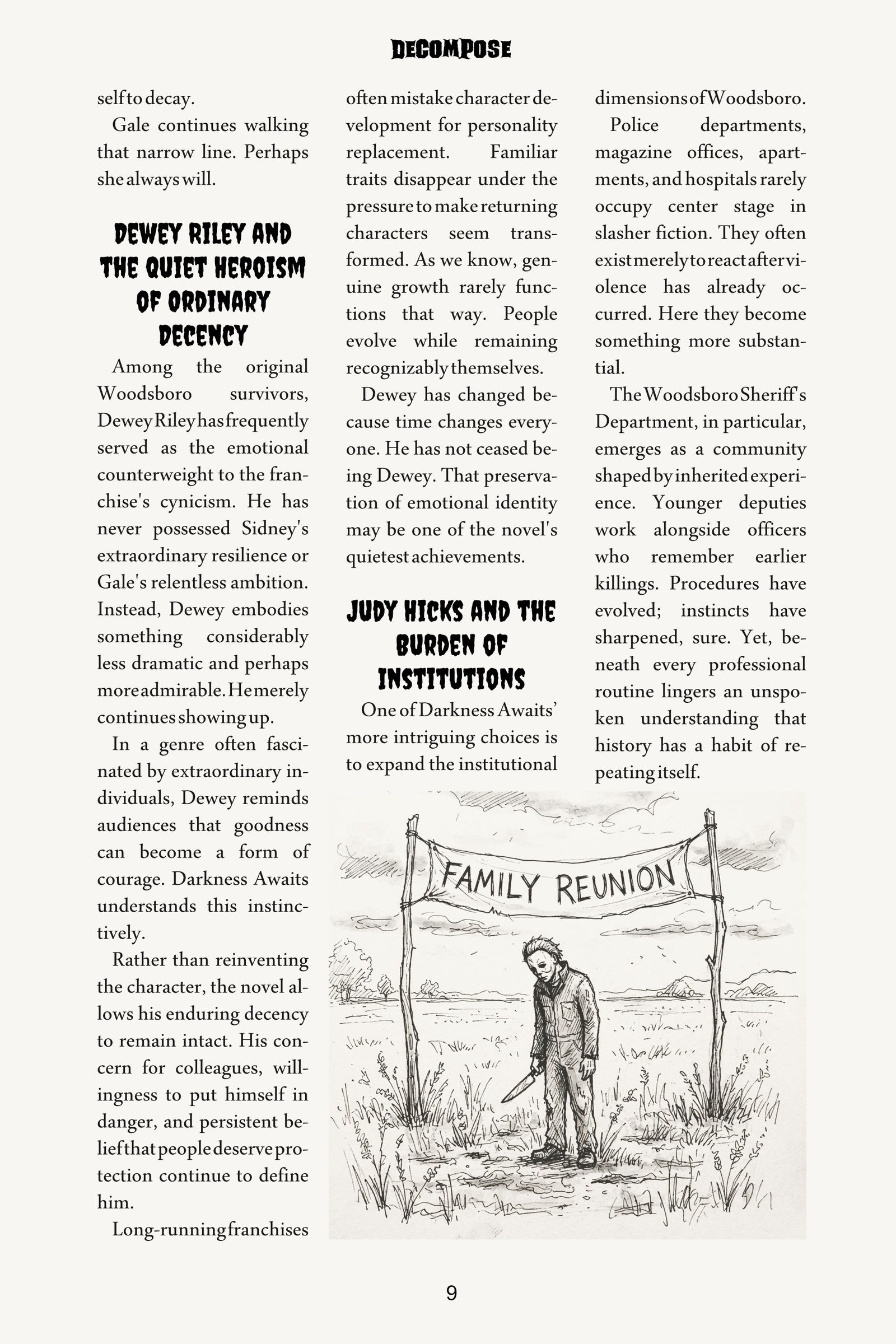
Unlike the supernatural elements of Haddonfield, Crystal Lake, or Elm Street, Woodsboro has never been haunted by anything beyond people of flesh and bone. No ancient curses hold a hidden grasp on the land, no zombies come up from beneath the soil, shapes of evil don’t lurk in the shadows. The terror arrives under a cheap Halloween costume, carrying an ordinary hunting knife, and speaking through a voice changer that anyone with enough money and resentment can purchase.
Perhaps that is why Woodsboro has remained such an enduring setting in modern horror. It isn't frightening because Ghostface always returns. It's frightening because Ghostface could be… someone you know. Residents of the small town live with the understanding that the next killer won't emerge from a chemical disaster, or even a magician casting the right spell, but from across the street, or… from across the dinner table. Every generation inherits some form of this.
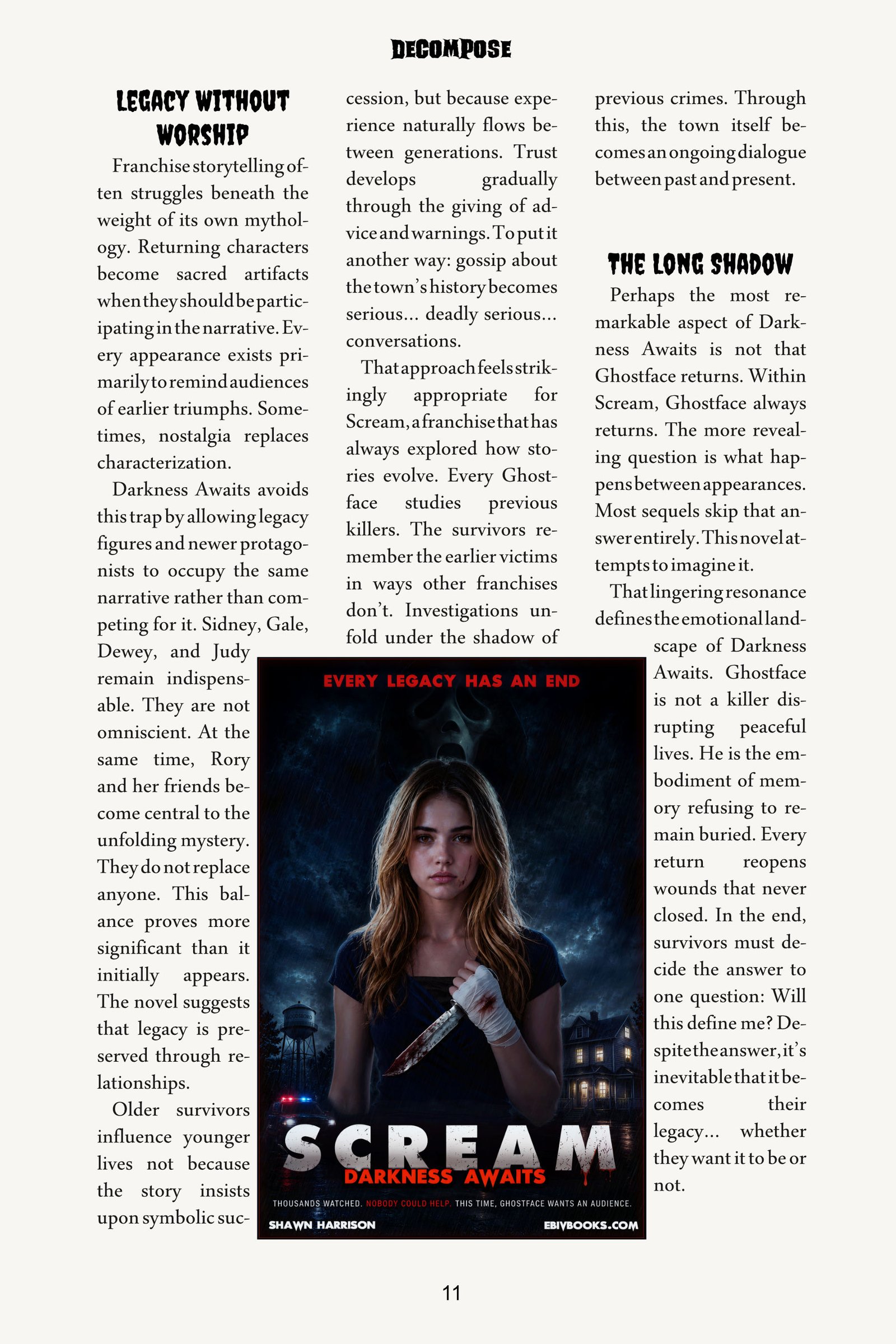
Scream: Darkness Awaits understands this before its first act of violence.
Rather than treating Woodsboro as a nostalgic backdrop for another mystery, the novel approaches the town as something closer to an archive. Time has passed—fifteen years since the events of Scream 4—yet history has not withdrawn into comfortable legend. It lingers in police reports, newspaper clippings, town gossip, and the cautious instincts of people who have learned that ordinary afternoons sometimes end with a body lying in a pool of blood.
The story's greatest accomplishment may be its refusal to present Woodsboro as "normal again."
Instead, it asks a more unsettling question:
Can a place living in the stench of repeated tragedy ever truly become ordinary again?
The answer isn't delivered through speeches or exposition. It emerges quietly, through routine. Woodsboro Community College students cross campus carrying backpacks. Coffee is poured at Garden Brew—Woodsboro’s small-town answer to Starbucks. Deputies joke with one another between assignments. Editors worry about deadlines. Neighbors wave from porches. Livestreams and podcasts are produced. Life moves forward. Fear is in the rearview. Yet the reader understands something the characters only realize once it’s too late. Ghostface is already walking among them.
That dramatic irony transforms the novel's early chapters into something fun, yet quite atmospheric, too. Readers familiar with Scream know violence is inevitable. The original characters inside the boundaries of the page do not. Despite what you’re reading, an invisible tension permeates because in Woodsboro the ordinary has become fragile.
This is where Darkness Awaits distinguishes itself from many contemporary slashers. The distinction is subtle, but it’s there. Modern horror often mistakes acceleration for suspense. Films and novels alike often rush toward the first kill, believing momentum alone can substitute for emotional investment. Because of this speed, scenes function more as spectacle than as tragedy, since audiences have barely met the victims.
The original film, Scream, understood something different.
Its opening sequence remains legendary not because Drew Barrymore—an actress who, in most movies of the time, would be the star—dies so quickly, but because audiences spend nearly twelve uninterrupted minutes watching Casey Becker exist before she's attacked. She jokes. She flirts. She makes popcorn. She teases a stranger over the phone. By the time Ghostface plunges a knife into her chest, viewers have unknowingly begun imagining the rest of her evening. The horror lies in realizing there won't be one.
Darkness Awaits adopts a remarkably similar philosophy, though on a broader scale. Rather than constructing suspense exclusively through stalking sequences and sudden attacks, the novel allows readers to inhabit the rhythms of Woodsboro itself. Relationships develop through seemingly insignificant exchanges. Characters complain about work, laugh at each other's jokes, worry about classes, think about pigeons, and make plans for tomorrow—a dangerous promise in Woodsboro.
The slower rhythm of Darkness Awaits is structural. Quiet scenes weave an interconnected bond between readers and characters. Each ordinary interaction accumulates emotional weight. When tragedy interrupts these routines, the loss extends beyond the individual victim. An entire network of conversations, friendships, and futures is severed alongside them.
That is Scream DNA. The franchise has never been interested solely in murder. It has always been interested in what murder interrupts.
The Geography of Trauma
One of the more intriguing aspects of Darkness Awaits is the way physical locations accumulate emotional history.
In many slasher stories, settings exist primarily as stages upon which violence occurs. Cabins, summer camps, abandoned hospitals—once the scene ends, the narrative moves elsewhere. Woodsboro functions differently. Locations have a memory. Or perhaps more accurately, the people who occupy them cannot forget.
The local magazine office is more than a workplace. It represents a town working to understand itself through journalism. The police station holds decades of unresolved investigations, procedural improvements, institutional memory, and officers who understand that another Ghostface is never impossible.
Even the quieter spaces possess a peculiar fragility. Restaurant dining rooms become places where old friends discuss pre-dinner drinks while standing on the edge of catastrophe. Living rooms host laughter that readers recognize could change to screams of terror. Bedrooms offer the veneer of safety without ever guaranteeing safety.
The novel rarely announces this thematic concern outright. Instead, it allows repetition to perform the work. Readers revisit familiar spaces as tension increases, which, in turn, manipulates emotional circumstances. A police interview room that once represented comfort gradually becomes associated with grief. A back alley in one chapter later feels fundamentally transformed in another. Psychologically speaking, violence alters architecture. It puts me in mind of the Led Zeppelin song, "The Song Remains the Same," because although the buildings and classrooms remain, their meanings change.
This is one of horror's oldest truths, dating back to Gothic fiction, in which ancestral homes became repositories of family secrets and collective guilt. Darkness Awaits adapts that tradition in suburban California, substituting ancestral homes for suburban streets.
Remembrance settles into brick and drywall just as readily as ancient memories settle into the stone at Stonehenge.
A Town Caught Between Generations
Perhaps the novel's most interesting decision is one that initially appears almost invisible.
It refuses to belong entirely to either generation. Many franchise continuations frame younger characters as replacements for older heroes. Others rely almost exclusively upon nostalgia, allowing familiar faces to overshadow everyone else.
Darkness Awaits does neither.
Instead, it imagines Woodsboro as a community where multiple generations live within the same landscape while establishing entirely different relationships to its history.
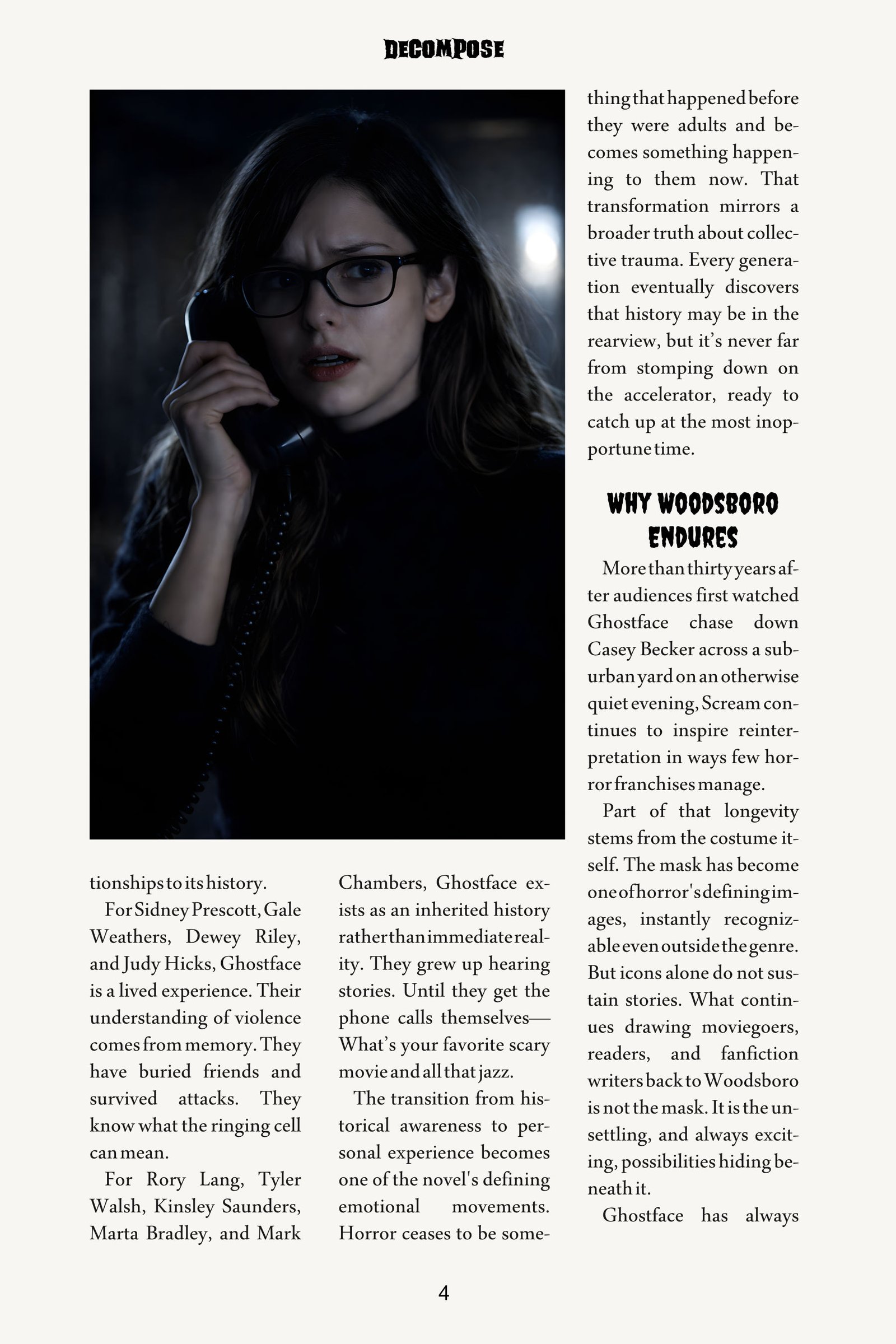
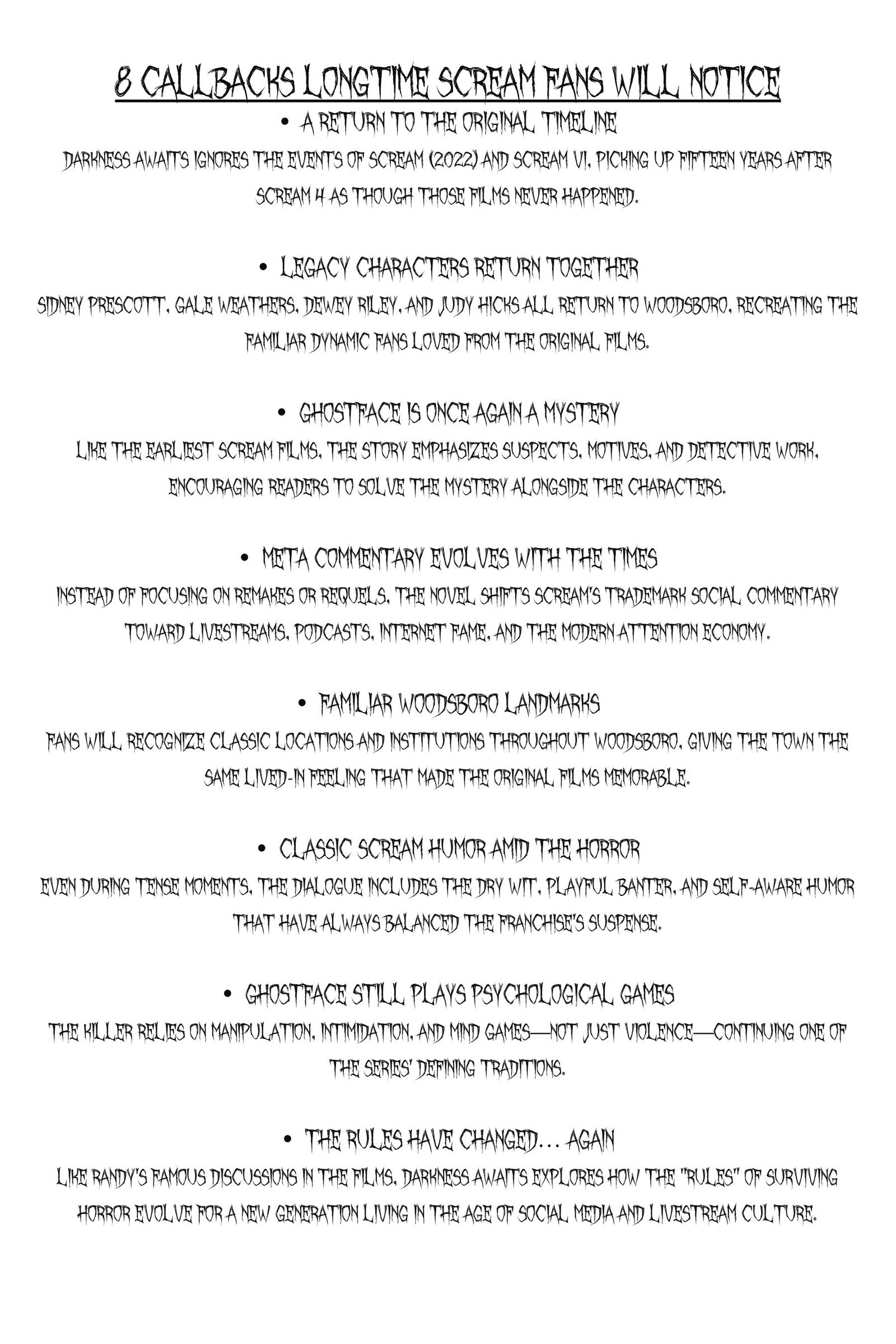
For Sidney Prescott, Gale Weathers, Dewey Riley, and Judy Hicks, Ghostface is a lived experience. Their understanding of violence comes from memory. They have buried friends and survived attacks. They know what the ringing cell can mean.
For Rory Lang, Tyler Walsh, Kinsley Saunders, Marta Bradley, and Mark Chambers, Ghostface exists as an inherited history rather than immediate reality. They grew up hearing stories. Until they get the phone calls themselves—"What's your favorite scary movie?" and all that jazz.
The transition from historical awareness to personal experience becomes one of the novel's defining emotional movements. Horror ceases to be something that happened before they were adults and becomes something happening to them now. That transformation mirrors a broader truth about collective trauma. Every generation eventually discovers that history may be in the rearview, but it's never far from stomping down on the accelerator, ready to catch up at the most inopportune time.
Why Woodsboro Endures
More than thirty years after audiences first watched Ghostface chase down Casey Becker across a suburban yard on an otherwise quiet evening, Scream continues to inspire reinterpretation in ways few horror franchises manage.
Part of that longevity stems from the costume itself. The mask has become one of horror's defining images, instantly recognizable even outside the genre. But icons alone do not sustain stories. What continues drawing moviegoers, readers, and fanfiction writers back to Woodsboro is not the mask. It is the unsettling, and always exciting, possibilities hiding beneath it.
Ghostface has always represented the terrifying idea that ordinary people remain unknowable. Friends carry private resentments. Romantic partners nurture hidden obsessions. Grief mutates into vengeance. Even strangers carry dark secrets. The fact is, identity almost always fractures beneath pressure. In an ironic way, the costume gives those impulses a face.
Scream: Darkness Awaits recognizes this central truth. Well before the road of mystery begins narrowing toward suspects and forking into revelations, the novel reminds readers that Ghostface is less a singular villain than a recurring symptom of unresolved human desire.
The murders matter. The reasons matter more. That understanding has defined Scream since 1996. It remains the reason Woodsboro never truly escapes its past. Because the town is not haunted by Ghostface. It is haunted by the possibility that someone, somewhere, is already wondering what it might feel like to wear the mask next.
Survival is not the end of the story.
Most slasher films and fiction conclude when their protagonists escape. Dawn arrives; the killer is defeated; audiences leave the theater believing the nightmare has ended while movie execs tally the numbers and decide whether the killer is actually dead. Whatever psychological consequences remain are implied rather than explored. Credits roll as trauma is conceived. Don’t even think about allowing it to age—that doesn’t sell tickets or books.
Or doesn’t it?
Scream has always resisted this. And it did the franchise well.
From the moment Sidney Prescott returned in Scream 2, these movies established a different understanding of survival. Escaping violence did not restore normalcy. Instead, it created another version of life—one shaped by memory and the uneasy realization that extraordinary horror can interrupt ordinary existence without warning.
Certainly, Scream has not been the only franchise to do this. Many have. However, this franchise handles this aspect with more care than other horror franchises.
That evolution transformed Sidney from a traditional "final girl" into something much rarer. She became a survivor in the fullest sense of the word. In other words, final girls are often defined by what they overcome; the survivor is defined by what he or she carries afterward.
Darkness Awaits builds much of its emotional architecture upon that distinction.
Rather than presenting its returning characters as untouchable legends, the novel allows them to exist as people who have continued living beyond the boundaries of previous stories. They have aged; careers have changed; relationships have deepened or… well… dissolved. New responsibilities have emerged. However, beneath these ordinary developments lies something impossible to erase: each has become a guardian of memories that empathetic minds can’t process without some degree of bending.
This is perhaps the novel's most mature creative decision. It understands that surviving repeated violence does not produce superheroes. Human beings who simply become very familiar with grief—that’s what Darkness Awaits understands.
Sidney Prescott and the Cost of Endurance
Few protagonists in modern horror have experienced the sustained narrative arc afforded to Sidney Prescott. Even if you remove the fifth and seventh films, as Darkness Awaits does, audiences have watched her transform from an ordinary teenager into an emblem of resilience across multiple films. Yet there has always been a danger in that transformation. Cultural icons tend to harden into symbols, gradually losing the vulnerability that first made them compelling.
An icon cannot surprise us. A person can, though. Darkness Awaits restores this humanity. Rather than depicting Sidney as an invincible veteran who anticipates every threat, the novel acknowledges something more emotionally truthful: experience breeds awareness. Immunity be damned. She understands Ghostface better than almost anyone alive. That knowledge offers no guarantee of peace, though it does offer an understanding that could help save a life… or not.
Indeed, it often becomes another burden. Every time her cell rings, or a headline announces fresh violence, memories she has spent years learning to live beside rather than overcome reawaken. Importantly, the novel never frames this as weakness.
This leads to another point. Modern popular culture often mistakes trauma for fragility, suggesting that characters either conquer their past or remain imprisoned by it. Reality is considerably more complicated. Memories can change shapes; they can fade. But they don’t disappear.
The Sidney readers encounter in Darkness Awaits reflects that complexity. She has built a life. She continues moving forward. Yet survival remains an active process. Her resilience doesn’t lie in forgetting. Consequently, it lies in refusing to allow recollections to become the author of her future.
That subtle distinction preserves the humanity that has always separated Sidney from many horror protagonists. She is remarkable because she repeatedly chooses to continue despite having every reason not to.
Gale Weathers and the Ethics of Remembering
If Sidney represents survival, Gale Weathers represents memory itself.
Journalists perform a peculiar function within horror. They document events that others wish to forget. Every article preserves tragedy. Like a seawall on the beach, it protects heartbreak against the gradual erosion of time. In lesser stories this role serves primarily as exposition. In Scream, it has always carried deeper implications.
Who owns a tragedy? The people who lived through it? Or the people who tell the world about it?
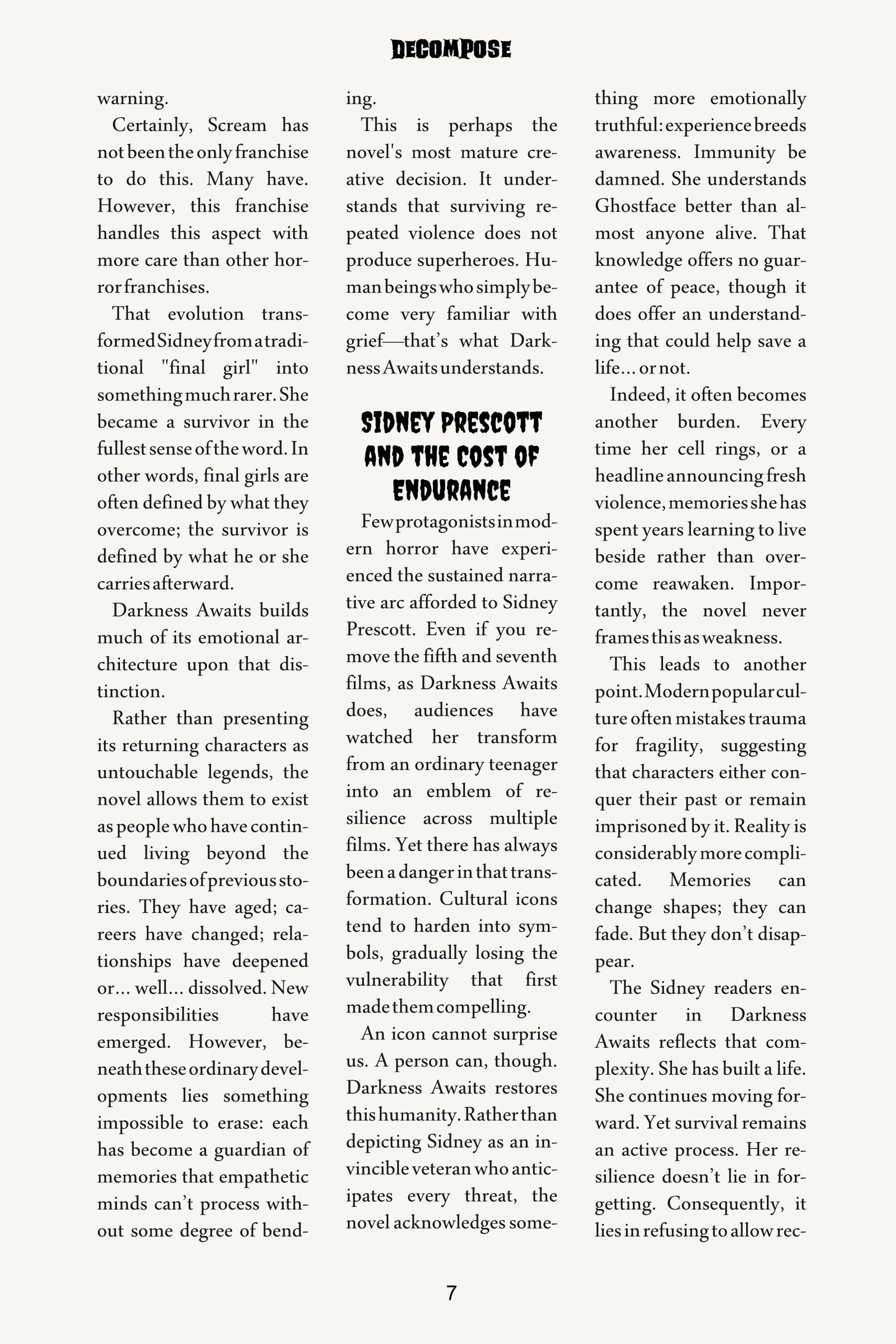
Throughout the franchise, Gale has occupied that uncomfortable intersection. She has been criticized—often justifiably—for turning violence into headlines. However, she has also ensured that the names of victims would endure. Often her ambition fights her empathy; it’s a constant negotiation.
Darkness Awaits inherits that contradiction.
Years have tempered Gale's priorities without erasing the instincts that first defined her career. She remains driven by journalism, but her pursuit of truth now carries noticeably greater emotional gravity. Reporting is no longer merely professional success. It has become a form of stewardship.
Someone must resist the comforting temptation to look away. In Woodsboro, this has always been Gale Weathers.
The novel refrains from presenting this responsibility as uncomplicated heroism. Like in the movies—and in real life—journalism remains ethically complex. Writing about violence risks transforming suffering into narrative. That’s life. Although refusing to document it allows memory itself to decay.
Gale continues walking that narrow line. Perhaps she always will.
Dewey Riley and the Quiet Heroism of Ordinary Decency
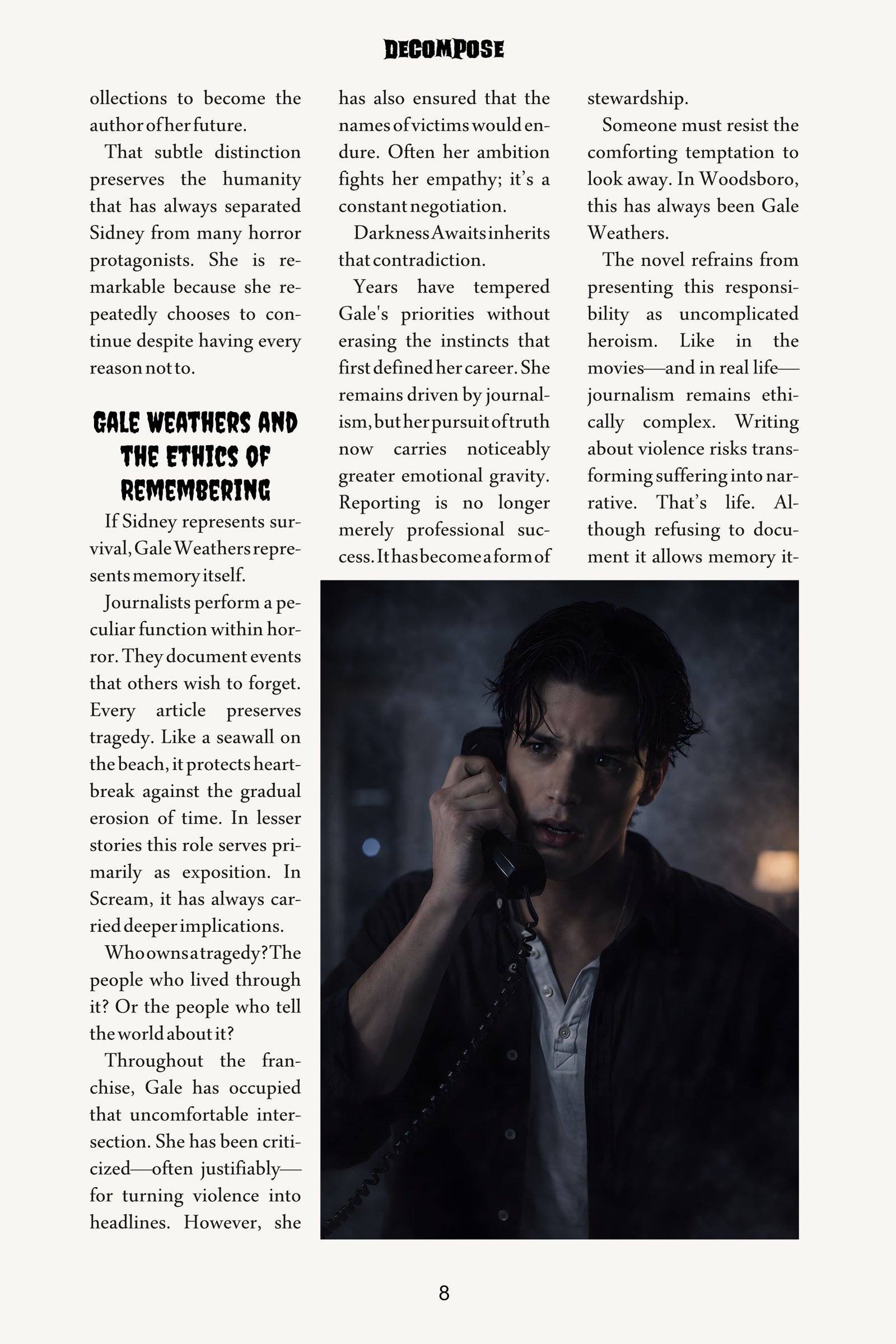
Among the original Woodsboro survivors, Dewey Riley has frequently served as the emotional counterweight to the franchise's cynicism. He has never possessed Sidney's extraordinary resilience or Gale's relentless ambition. Instead, Dewey embodies something considerably less dramatic and perhaps more admirable. He merely continues showing up.
In a genre often fascinated by extraordinary individuals, Dewey reminds audiences that goodness can become a form of courage. Darkness Awaits understands this instinctively.
Rather than reinventing the character, the novel allows his enduring decency to remain intact. His concern for colleagues, willingness to put himself in danger, and persistent belief that people deserve protection continue to define him.
Long-running franchises often mistake character development for personality replacement. Familiar traits disappear under the pressure to make returning characters seem transformed. As we know, genuine growth rarely functions that way. People evolve while remaining recognizably themselves.
Dewey has changed because time changes everyone. He has not ceased being Dewey. That preservation of emotional identity may be one of the novel's quietest achievements.
Judy Hicks and the Burden of Institutions
One of Darkness Awaits' more intriguing choices is to expand the institutional dimensions of Woodsboro.
Police departments, magazine offices, apartments, and hospitals rarely occupy center stage in slasher fiction. They often exist merely to react after violence has already occurred. Here they become something more substantial.
The Woodsboro Sheriff's Department, in particular, emerges as a community shaped by inherited experience. Younger deputies work alongside officers who remember earlier killings. Procedures have evolved; instincts have sharpened, sure. Yet beneath every professional routine lingers an unspoken understanding that history has a habit of repeating itself.
Judy Hicks occupies the center of this institutional memory. Unlike Sidney or Gale, her relationship to Ghostface has always been filtered through public service rather than private identity. She does not just survive attacks; she prepares for future ones. Her job demands this.
This difference grants her presence unusual thematic importance. Judy represents the uncomfortable reality that communities adapt to recurring violence without ever fully escaping it.
Rory Lang and the Inheritance of Fear
Every generation eventually reaches the moment when inherited stories become personal experience. Children hear about wars fought before they were born; then, one day, conflict arrives on their doorstep. Students read about disasters in textbooks until tragedy unfolds outside their bedroom windows. History remains comfortably distant until it suddenly becomes immediate. No one is ever prepared for this.
Rory Lang embodies that transition. When readers first encounter her, Ghostface belongs to Woodsboro's collective memory rather than her own. That distance gradually collapses.
The novel never rushes this progression. Instead, it allows readers to watch Rory's understanding evolve in measured increments. Familiar assumptions erode over time. Certainty gives way to vigilance. Everyday routines—like watching a boy play with his dog—acquire unexpected fragility.
What emerges is not simply another battle-hardened slasher character; it is a portrait of someone discovering that inherited fear eventually demands personal interpretation.
How does one prepare for horror that previous generations insist is possible but hope will never return? There is no instruction manual.
Legacy Without Worship
Franchise storytelling often struggles beneath the weight of its own mythology. Returning characters become sacred artifacts when they should be participating in the narrative. Every appearance exists primarily to remind audiences of earlier triumphs. Sometimes, nostalgia replaces characterization.
Darkness Awaits avoids this trap by allowing legacy figures and newer protagonists to occupy the same narrative rather than competing for it. Sidney, Gale, Dewey, and Judy remain indispensable. They are not omniscient. At the same time, Rory and her friends become central to the unfolding mystery. They do not replace anyone. This balance proves more significant than it initially appears. The novel suggests that legacy is preserved through relationships.
Older survivors influence younger lives not because the story insists upon symbolic succession, but because experience naturally flows between generations. Trust develops gradually through the giving of advice and warnings. To put it another way: gossip about the town’s history becomes serious… deadly serious… conversations.
That approach feels strikingly appropriate for Scream, a franchise that has always explored how stories evolve. Every Ghostface studies previous killers. The survivors remember the earlier victims in ways other franchises don’t. Investigations unfold under the shadow of previous crimes. Through this, the town itself becomes an ongoing dialogue between past and present.
The Long Shadow
Perhaps the most remarkable aspect of Darkness Awaits is not that Ghostface returns. Within Scream, Ghostface always returns. The more revealing question is what happens between appearances. Most sequels skip that answer entirely. This novel attempts to imagine it.
That lingering resonance defines the emotional landscape of Darkness Awaits. Ghostface is not a killer disrupting peaceful lives. He is the embodiment of memory refusing to remain buried. Every return reopens wounds that never closed. In the end, survivors must decide the answer to one question: Will this define me? Despite the answer, it’s inevitable that it becomes their legacy… whether they want it to be or not.
Every era receives the Ghostface it deserves.
That has always been one of Scream's strengths.
Looking back at the franchise, each killer reflects the anxieties of the moment in which they were created. In 1996, Ghostface emerged from a decade saturated with media sensationalism and true-crime fascination. Hard Copy, A Current Affair, Inside Edition… the shows never ended. Murders became inseparable from television coverage and the realization that violence itself had become entertainment.
Later entries shifted their attention toward sequels, remakes, internet fandom, elevated horror, and the increasingly self-aware language through which audiences consumed popular culture. Each installment understood that horror never exists in isolation. It absorbs the fears, obsessions, and technologies of its own moment.
Scream: Darkness Awaits continues that tradition, but it does so by asking a question uniquely suited to the twenty-first century: What happens when the audience is no longer merely watching the horror? What happens when the audience becomes part of it?
From Witnesses to Participants
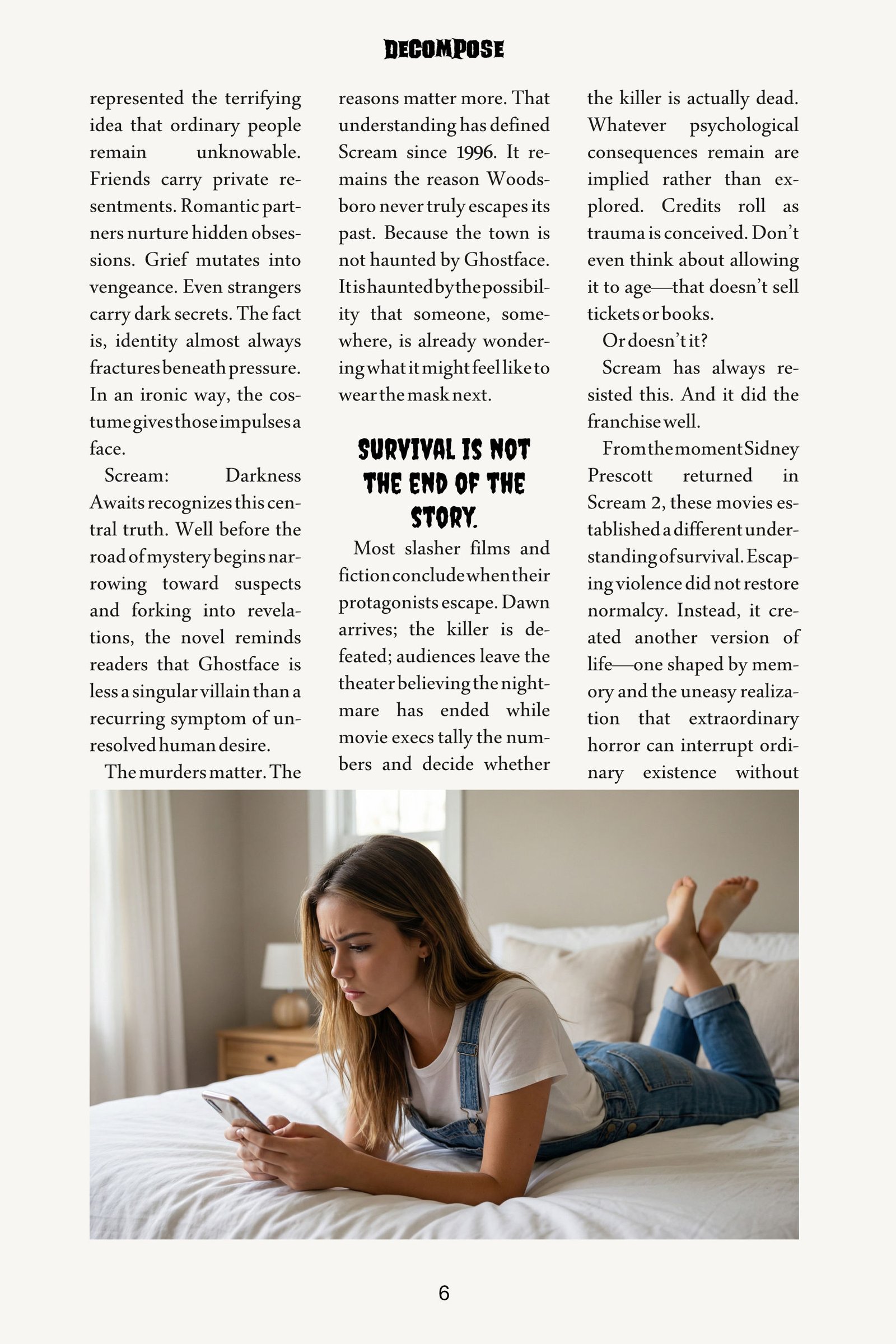
For most of horror's history, the relationship between viewer and violence has remained distant. The audience watches while eating popcorn. The victims suffer on screen while collecting a check after the director yells cut. The screen provides a reassuring barrier between observation and participation. Digital culture has worn down that boundary.
Modern audiences now have an option to consume events in a much different way. They react to, comment on, clip, and remix videos. They livestream themselves watching them. The experience of witnessing a viral TikTok now carries the possibility of becoming a performance for the viewer.
Even grief has acquired an audience. It is this transformation that gives Darkness Awaits much of its thematic identity. The novel does not argue that technology itself creates monsters. That would be a simplistic conclusion, and one inconsistent with Scream's long-standing insistence that people commit atrocities.
Instead, the story explores something more unsettling. Does tech change incentives? Influence is quantified through views, followers, engagement, and subscriber counts. In a time when visibility has become currency, and attention can be measured, the desire to be seen can quietly evolve into the desire to be unforgettable. Horror has always understood the dangers of obsession.
Darkness Awaits relocates that obsession into the architecture of contemporary media. It's something the author of this fan fiction doesn't fully understand. In part, that's why they decided to write this story—to try and understand it.
Performance Without an Audience Is No Longer Enough
There is a curious paradox at the center of internet culture. People increasingly document experiences they have not yet fully lived. Vacations become content before they become memories. Meals become photographs before they're eaten. Personal triumphs are frequently measured by public response rather than private satisfaction.
Because of this, existence grows increasingly performative. The novel recognizes this phenomenon. Instead of reducing it to satire, it asks what happens when violence enters that same economy of attention.
No matter who wore the Ghostface mask, they always performed. From the theatrical phone calls to the costume, from the carefully staged crime scenes to the dramatic reveals. Murder has always possessed an element of spectacle within the franchise.
What changes in Darkness Awaits is not the performance itself. It is the audience. Violence no longer seeks witnesses merely to inspire fear, but to generate engagement. In this way, the novel fundamentally alters the emotional landscape.
The Collapse of Privacy
Perhaps no generation has experienced a more dramatic redefinition of privacy than the one currently coming of age.
Boundaries separating public and private life have become progressively permeable. Personal conversations migrate to social platforms, and romantic relationships unfold beneath digital scrutiny. Visibility has become normal. When one seeks this attention, it's bliss. However, they sacrifice future privacy for it.
Within Darkness Awaits, this cultural shift creates an especially unsettling tension. Traditional slashers often rely upon isolation. Victims become separated from help. Communication fails. Engines don't start, and the telephones stop working. Technology often functioned as something horror needed to overcome.
Modern technology complicates that formula. People are now constantly connected. Horror writers have had to adapt. But during this transition, many discovered something wonderful. Connection does not necessarily produce safety.
Indeed, perpetual visibility may create entirely new vulnerabilities. When information spreads instantly, rumors spread faster and fear becomes communal before facts ever arrive.
The novel quietly explores this altered landscape, suggesting that contemporary horror lies not in the absence of communication, but in its overwhelming abundance.
Everyone sees… and some even enjoy it.
Ghostface in the Age of Algorithms
One of the franchise's enduring insights has always been that Ghostface adapts. The motives evolve, sure—Billy Loomis weaponized resentment, Mrs. Loomis weaponized grief, while Roman Bridger weaponized abandonment. Every incarnation revealed something about the era that produced it.
Darkness Awaits extends that tradition by exploring recognition as motivation. Not fame in its traditional sense, but the human desire to avoid disappearing unnoticed into the endless flow of information that defines modern existence.
Algorithms reward visibility. Social platforms reward engagement. The attention economy encourages dramatic forms of self-presentation. Many navigate these incentives without getting cut by the digital razor wire that protects the peasants from those with millions of subs. Then again, some do not.
The novel never argues that online culture produces violence. Instead, it examines how ordinary insecurities can become amplified inside systems built to reward constant exposure. For that reason, Ghostface emerges because technology magnifies desires already present within human nature.
That distinction keeps the story grounded in the psychological concerns that have always defined Scream. The knife has always remained sharp. The reasons for picking it up never stop evolving.
Horror as Reflection
The original Scream exposed the uneasy relationship between violence and entertainment at precisely the moment popular culture was becoming increasingly fascinated with both. Viewed today, that commentary feels almost prophetic.
Darkness Awaits follows a similar instinct. The novel is less interested in condemning internet culture than in observing it carefully. Its younger characters are not caricatures addicted to technology. They communicate the way contemporary young adults communicate. They create, edit, stream, and consume media.
These activities are presented not as moral failings but as ordinary aspects of modern life. The story refuses to divide the world into simplistic categories of "good" analog past and "corrupt" digital present. Instead, it recognizes continuity. If there's one constant throughout the history of the human race, it's that people desire attention. Modern platforms merely changed the scale upon which attention operates.
Ghostface exploits that reality because Ghostface has always exploited whatever emotional vulnerabilities already existed.
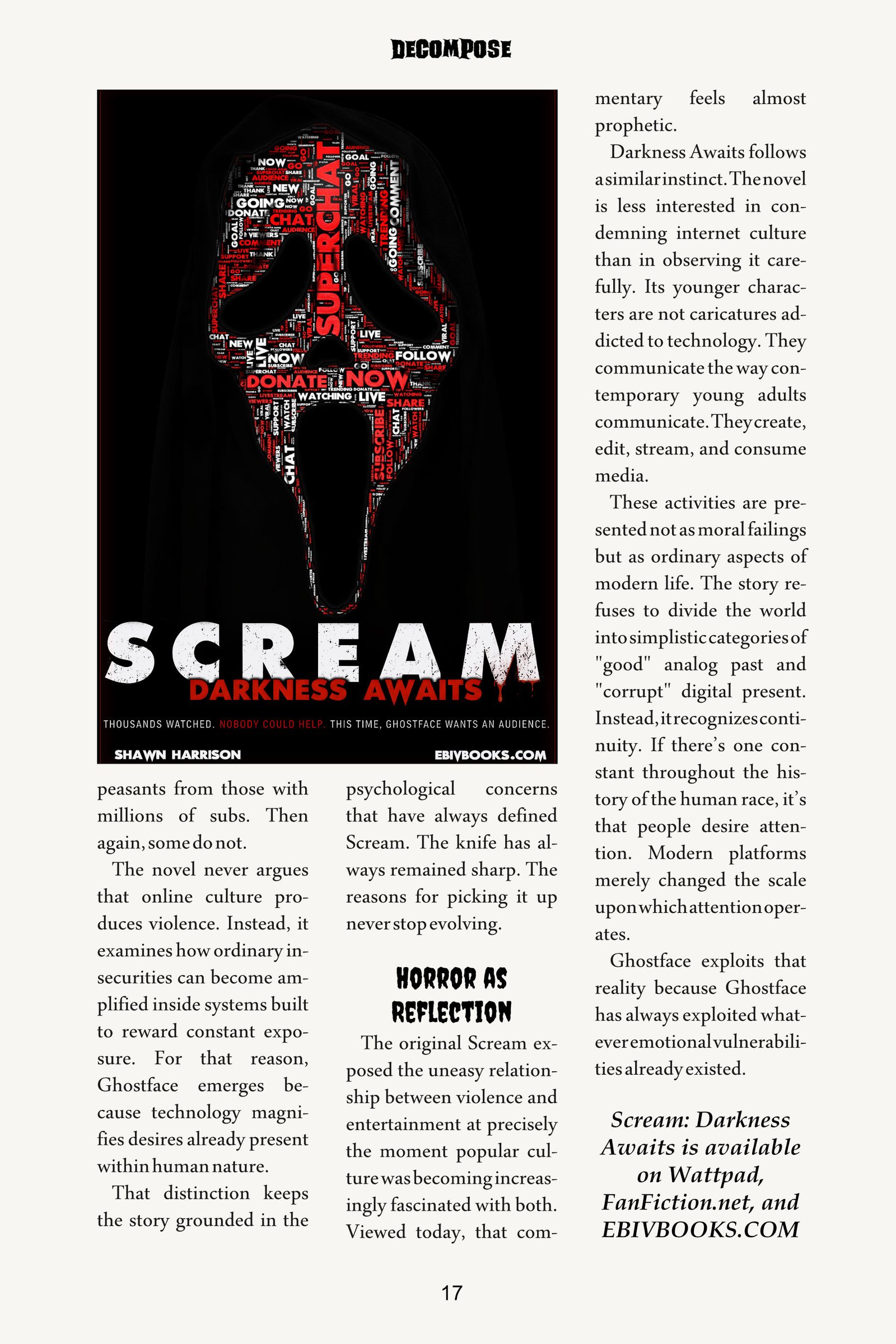
Scream: Darkness Awaits is available on Wattpad, FanFiction.net, and EBIVBOOKS.COM.